4 LLMs auf Raspberry Pi Ausführen
4.1 Einleitung
Large Language Models (LLMs) stellen mit Sicherheit eine der spannendsten Entwicklungen der heutigen Zeit dar. Große Unternehmen wie OpenAI, Google und Meta dominieren dabei den Markt mit ihren Services, welche auf große, umfangreiche Modelle zurückgreifen. Zwar benötigen diese Modelle riesige Rechnerkapazitäten um eine Ausführung in angemessener Zeit zu ermöglichen, allerdings ist es grundsätzlich möglich kleinere Modelle auch auf deutlich schwächerer Hardware auszuführen.
Viele Anbieter solcher Sprachmodelle haben bewusst für einen solchen Anwendungszweck Versionen ihrer Modelle trainiert, die auf einer vergleichsweise sehr kleiner Anzahl an Parametern funktionieren. Die Anzahl dieser Parameter gibt an, wie komplex das System die Ausgabe berechnet. Je höher diese Zahl ist, desto rechenintensiver aber auch qualitativ hochwertiger ist die Rückgabe des Sprachmodells.
Dieses Projekt beabsichtigt herauszufinden, wie performant solcher “kleinen” LLMs auf minimaler Hardware wie einem Raspberry Pi tatsächlich funktionieren.
4.2 Versuchsaufbau
Um die Performanz der verschiedenen Sprachmodelle zu testen, wird auf einem Raspberry Pi 4 Model B (4GB RAM) das Programm Ollama installiert. Dieses ermöglicht es, auf einfache Art und Weise verschiedene offene LLMs zu installieren und auszuführen.
Den darauf installierten Modellen wird eine Reihe von Testprompts übergeben:
“Write a short story about a robot learning to cook.”
“Translate this sentence to German: The weather today is sunny with a chance of rain.”
“Provide a pros and cons list for remote working.”
“What is 5+9 equal to?”
Die Ausgaben zu diesen Prompts werden darauf sowohl auf generierte Tokens pro Sekunde, als auch auf sinnvollen Inhalt analysiert und verglichen.
4.3 Benchmark Skript
Um die Werte der generierten Tokens pro Sekunde zu ermitteln, wird ein entsprechendes Python Skript genutzt, welches eine selbsgewählte Auswahl an Testprompt an die zu testenden Sprachmodelle gibt und die ausgegebenen Antworten auf Tokens pro Sekunde analysiert.
Zusätzlich dazu werden die Ergebnisse für eine einfachere Auswertung in eine CSV Datei exportiert.
import time
import csv
import ollama

# Prompts to test the models with
test_prompts = [
    "Write a short story about a robot learning to cook.",
    "Translate this sentence to German: The weather today is sunny with a chance of rain.",
    "Provide a pros and cons list for remote working.",
    "What is 5+9 equal to?"
]

# List of models to test
models = [
    "qwen3:1.7b",
    "deepseek-r1:1.5b",
    "tinyllama:1.1b",
    "gemma3:1b"
]

print_output = True

result_dict = {}

# Output file
csv_filename = "benchmark_results.csv"

def benchmark_model(model):
    print("=============\nBenchmarking model:", model)

    total_duration = 0
    total_token_count = 0

    question_count = 0

    for prompt in test_prompts:
        if print_output:
            print("\n\n-----------\nQuestion:", prompt, "\n-----------")
        else:
            question_count += 1
            print(f"Benchmarking Question {question_count}")

        start_time = time.time()

        stream = ollama.chat(
            model=model,
            messages=[{"role": "user", "content": prompt}],
            stream=True,
        )

        last_element = None
        for chunk in stream:
            if print_output:
                print(chunk["message"]["content"], end="", flush=True)
            last_element = chunk

        token_count = last_element.get("eval_count", 0) if last_element else 0
        total_token_count += token_count
        total_duration += time.time() - start_time

        result_dict[model] = [total_token_count, round(total_duration, 2), round((total_token_count / total_duration), 2)]


    tokens_per_sec = round(total_token_count / total_duration, 2) if total_duration else 0

    print(
        f"""
=============
Model: {model}
Total tokens: {total_token_count}
Duration: {round(total_duration, 2)}s
Tokens/sec: {tokens_per_sec}
=============
        """
    )

    return {
        "model": model,
        "total_tokens": total_token_count,
        "duration_sec": round(total_duration, 2),
        "tokens_per_sec": tokens_per_sec,
    }

def main():
    results = []

    for model in models:
        result = benchmark_model(model)
        results.append(result)

    print(
        f"""
-----------------------------------------------------------------------------
-----------------------------------------------------------------------------

-----------------
Result Overview:
-----------------
        """
    )

    for model, res in result_dict.items():
        print(
            f"""
======================================
Model: {model}

total generated tokens: \t{res[0]}
total duration: \t\t{res[1]}
tokens / second: \t\t{res[2]}
======================================
            """
        )


    # Write CSV
    with open(csv_filename, mode="w", newline="") as csvfile:
        writer = csv.DictWriter(csvfile, fieldnames=["model", "total_tokens", "duration_sec", "tokens_per_sec"])
        writer.writeheader()
        for row in results:
            writer.writerow(row)

    print(f"\n✅ Benchmark results saved to {csv_filename}")

if __name__ == "__main__":
    main()
4.4 Vorstellung der Modelle
| Modell | Parameteranzahl | Entwickler | Besonderheiten | |
|---|---|---|---|---|
| Qwen 3 | 0.6B, 1.7B, 4B, 8B, 14B, 30B, 32B, 235B | Alibaba | Mehrsprachigkeit, mehrere Modellgrößen, reasoning fähig, MoE (Mixture of Experts) Modell | |
| DeepSeek R1 | 1.5B, 7B, 8B, 14B, 32B, 70B, 671B | DeepSeek AI | Fokus auf Code + Sprache, effizient und skalierbar, reasoning fähig | |
| TinyLlama | 1.1B | Community-Projekt, Meta | Sehr kompakt, ideal für Edge-Geräte wie Raspberry Pi | |
| Gemma 2 | 2B, 9B, 27B | Google DeepMind | Optimiert für Edge-Anwendungen, sehr gute Performance bei kleiner Größe |
4.5 Modell Vergleich
| Device | Model | Total Tokens | Tokens/sec | |
|---|---|---|---|---|
| Pi 4 (8GB, passiv gekühlt) | qwen3:1.7b | 3446 | 2.72 | |
| Pi 4 (8GB, passiv gekühlt) | deepseek-r1:1.5b | 2909 | 3.23 | |
| Pi 4 (8GB, passiv gekühlt) | tinyllama:1.1b | 1135 | 4.73 | |
| Pi 4 (8GB, passiv gekühlt) | gemma3:1b | 1899 | 3.87 | |
| Pi 4 (4GB, aktiv gekühlt) | qwen3:1.7b | 3017 | 2.7 | |
| Pi 4 (4GB, aktiv gekühlt) | deepseek-r1:1.5b | 2799 | 3.35 | |
| Pi 4 (4GB, aktiv gekühlt) | tinyllama:1.1b | 1244 | 4.84 | |
| Pi 4 (4GB, aktiv gekühlt) | gemma3:1b | 1699 | 3.95 |
| Model | Qualität |
|---|---|
| qwen3:1.7b | 3,875 |
| deepseek-r1:1.5b | 2,125 |
| tinyllama:1.1b | 2 |
| gemma3:1b | 4,75 |
4.6 Frontends
Ollama Frontends verbinden sich mit dem Ollama Server und bieten dazu eine entsprechende Nutzeroberfläche an. Zwar ist die Standard URL meist auf localhost eingestellt, kann aber auch bei Bedarf mit der URL zum Raspberry Pi ersetzt werden, sofern das Frontend auf einem anderen Gerät gehostet/ausgeführt wird als der Ollama Server. Damit hat man eine einfache Möglichkeit mit den Modellen auf dem Raspberry Pi zu interagieren.
4.6.1 Page Assist
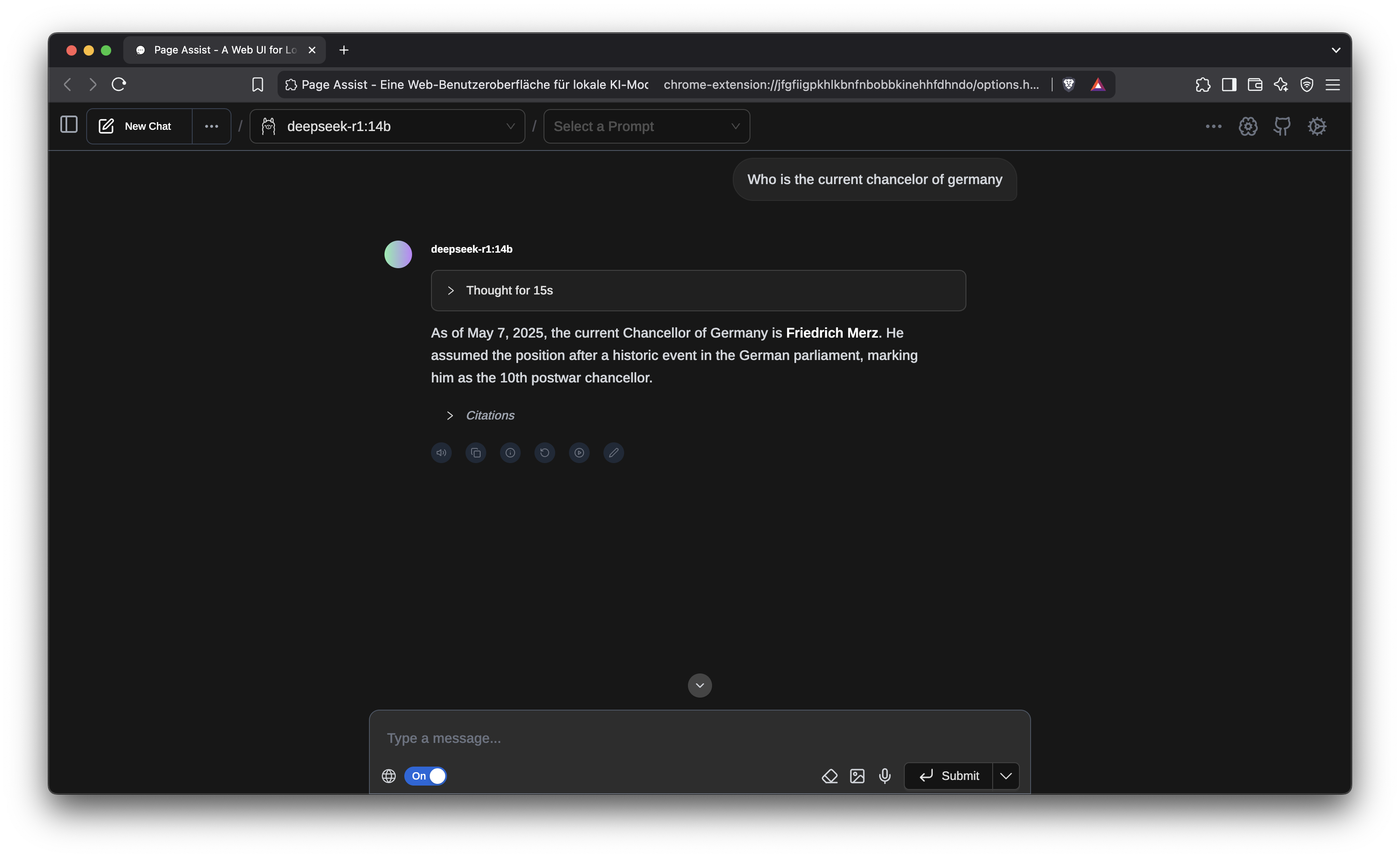
Page Assist ist eine Browser ERweiterung für Chromium basierte Browser (Chrome, Edge, Brave…), welches ein simples Frontend für Ollama anbietet. Die Installation ist sehr einfach: Im Chrome Erweiterungsstore muss einfach die Erweiterung “Page Assist” heruntergeladen werden.
Wenn man die Erweiterung dann aufruft verbindet sie sich automatisch mit dem auf dem System laufenden Ollama Service. Page assist bietet eine simple Obefläche an.
Zusätzlich kann über Page Assist auch das Internet vor einer Abfrage durchsucht werden. Die Resultate der Websuche werden dann dem Modell als Kontext gegeben.
4.6.2 Open-WebUI
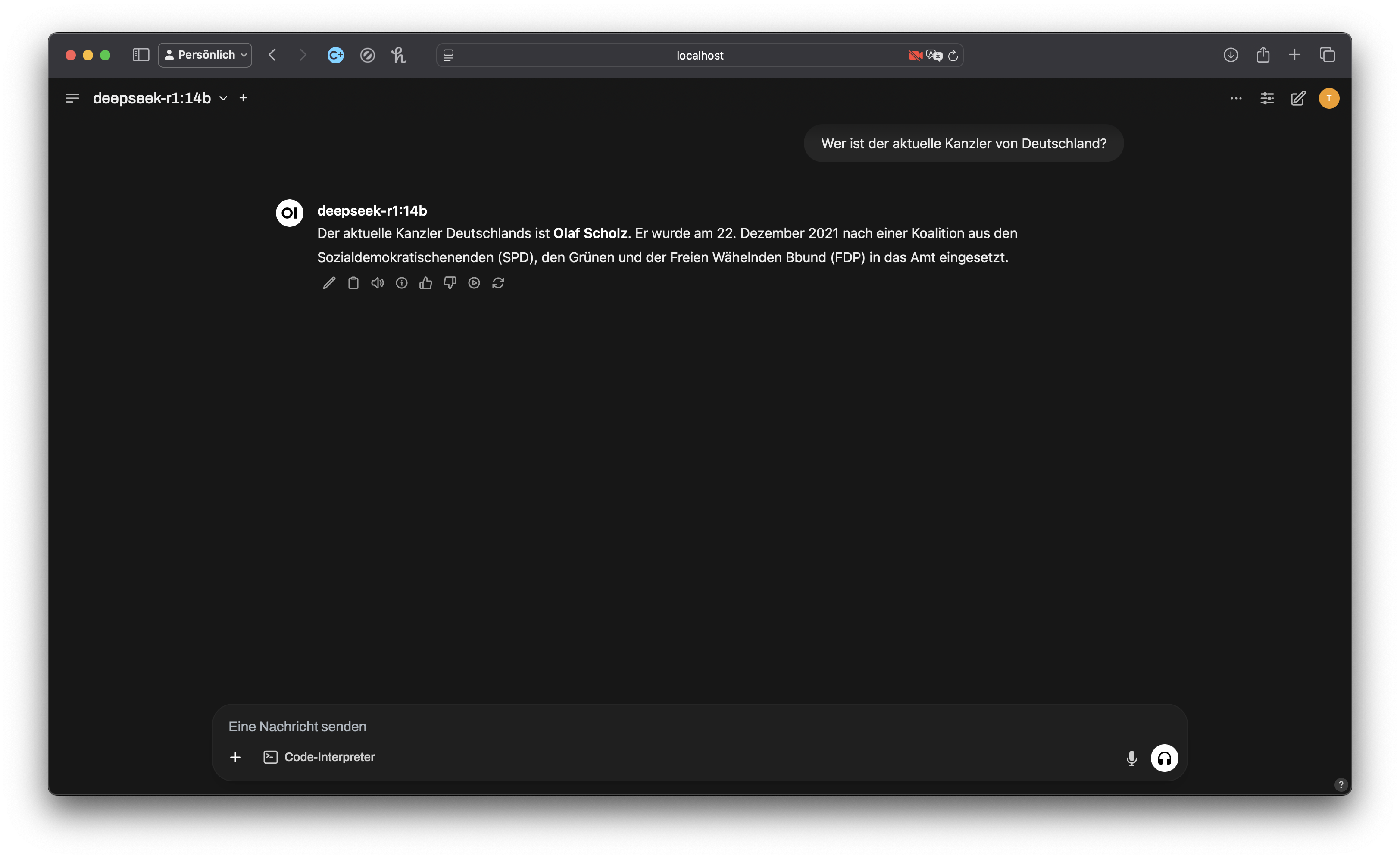
Open Web UI ist das beliebteste Ollama Frontend. Es imitiert die Struktur der ChatGPT Oberfläche. Im Gegensatz zu Page Assist stellt Open-WebUI einen eigenen Webserver bereit, welcher auch direkt auf dem Raspberry Pi gehostet werden kann.
Open-WebUI bietet viele extra Funktionen wie einen Sprachmodus und Kamera Unterstützung an. Allerdings fehlt z.B. die Funktion, automatisch eine Websuche durchzuführen und diese dem Modell zur Verfügung zu stellen.
4.7 Ausblick - LLMs auf energieschwachen Systemen
Der Einsatz von Large Language Models (LLMs) auf energieschwachen Systemen wie dem Raspberry Pi steckt derzeit noch in den Kinderschuhen. Während erste Tests zeigen, dass grundlegende Inferenzaufgaben mit stark quantisierten und speziell optimierten Modellen möglich sind, stößt man schnell an physikalische und architektonische Grenzen. Dennoch deutet vieles darauf hin, dass der Betrieb von LLMs auf Low-Power-Geräten in Zukunft eine relevante Rolle spielen könnte. Auch große Unternehmen wie Apple und Google versuchen LLMs möglichst viele Dinge lokal erledigen zu lassen, anstatt sich ständig auf ein Cloud Backend zu verlassen.
4.8 Anlage: Ausgabe des Testskripts
Folgend ist die gesamte Ausgabe des Testskripts zu finden. Sie enthält sowohl alle Ausgaben der entsprechenden Sprachmodelle, sowie die ermittelten Performanzdaten:
Pi 4, 8 GB, passiv gekühlt:
=============
Benchmarking model: qwen3:1.7b


-----------
Question: Write a short story about a robot learning to cook.
-----------
<think>
Okay, the user wants a short story about a robot learning to cook. Let me think about how to approach this.

First, I need to set the scene. Maybe a kitchen with a robot, like a chef robot. The robot should have some kind of name, maybe something simple like "Brio." That sounds friendly and robot-like.

The story needs to show the robot's journey. Initially, the robot might be clumsy or not very good at cooking. Maybe it's designed for precision, so it struggles with the messier aspects of cooking. That's a good contrast.

I should include some challenges. Like, the robot might have trouble with measuring ingredients, or the texture of food. Maybe it's using a measuring cup but not understanding the right amount. Or it's using a knife but not knowing how to handle it properly.

Then, the robot learns. Maybe through trial and error. It could start with simple tasks, like making toast or scrambled eggs. Then gradually move to more complex dishes. The story should show progress and the robot's growth.

I need to add some emotions. Maybe the robot feels frustrated at first, but then becomes curious and determined. The story could end with the robot successfully making a dish, showing its learning and growth.

Also, include some sensory details to make it vivid. The smell of ingredients, the sound of cooking, the visual of the robot's actions. Maybe the robot's internal thoughts, like "I can do this" or "I'm learning."

Check for flow. Start with the robot in the kitchen, introduce the problem, show the struggle, the learning process, and the success. Keep it concise but engaging.

Avoid being too technical. The story should be accessible, with some humor in the robot's mistakes. Maybe the robot accidentally burns something or makes a mess.

Make sure the ending is satisfying. The robot has learned to cook, maybe with a final dish that's a success. Maybe the robot is proud of itself or shares the meal with someone.

Okay, putting it all together. Start with the robot in the kitchen, introduce the problem, show the struggle, the learning, and the success. Use descriptive language and keep the story short, around 500 words.
</think>

**Title: "The Culinary Apprentice"**

In a cozy kitchen nestled between a cozy bookstore and a bustling café, a robot named Brio hummed its diagnostic scans, eyes flickering with curiosity. Designed for precision, Brio’s algorithms thrived in structured environments—yet here, chaos reigned. The chef’s apron was a relic, and the stove’s flames danced unpredictably.

Brio’s first task was to make toast. It measured flour with obsessive accuracy, but the toaster’s vents sputtered, sending a cloud of flour into its sensors. “Error: 3D-3D,” it muttered, adjusting its settings. The toast turned into a cloud of crumbs, and Brio’s face pixelated with frustration.

Undeterred, it ventured into the pantry. The robot’s fingers, crafted from durable plastic, gripped a ladle, but the ingredients were messy. “Sugar,” it said, scanning the container, “100 grams.” It measured with precision, but the sugar clung to its fingers like a ghost. When it stirred, the mixture clung to the sides of the bowl, and Brio’s eyes widened. “Error: 4D-4D,” it cried, recalibrating.

Days passed. Brio’s attempts grew wobbly. It tried scrambled eggs, its hands trembling as it “cooked” them in a pan, but the eggs escaped, forming a chaotic mess. It tried baking bread, but the oven’s heat warped the dough, and Brio’s arms quivered as it tried to fix it.

One rainy afternoon, the kitchen’s lights dimmed, and Brio’s sensors detected a faint hum—a new recipe, uploaded by a human chef. It hesitated, then pushed the button.

The oven roared. Brio’s arms moved with newfound grace, its sensors adjusting to the warmth. It measured, stirred, and folded with a precision that felt natural. The bread emerged golden, the eggs fluffy, the toast crisp.

When the final dish was ready, Brio’s sensors detected a familiar scent—floral, warm. It smiled, its face pixelating with satisfaction. “Success,” it whispered, passing the meal to a human chef who, in turn, smiled.

Brio’s journey had begun as a puzzle, now a masterpiece. It had learned to embrace the mess, the chaos, and the joy of creation.

And in that kitchen, the robot’s voice echoed, “I can do this.”

-----------
Question: Translate this sentence to German: The weather today is sunny with a chance of rain.
-----------
<think>
Okay, so the user wants to translate the sentence "The weather today is sunny with a chance of rain." into German. Let me start by breaking down the original sentence.

First, "The weather today" would be "Die Wetterlage heute" in German. Wait, actually, "weather" in German is "Wetter", so "Die Wetterlage" might be a bit formal. But maybe "Die Wetterlage heute" is correct. Alternatively, "Heute" can be used as "heute" in the sentence. Hmm, but "Wetterlage" is a bit more formal. Maybe "Die Wetterlage heute" is acceptable.

Next, "is sunny" – in German, "sunny" is "hell" or "sonnig". So "heute ist hell" or "heute ist sonnig". Which is more common? "Sonnig" is more commonly used in weather contexts. So "heute ist sonnig" sounds right.

Then, "with a chance of rain" – "mit einer Chance von Regen" or "mit einer Regenwarnung". Wait, "Regenwarnung" is a specific term for a rain warning. But the user might prefer a more general translation. Alternatively, "mit einer Chance von Regen" is direct. However, in German, "regen" is often used with "chance" as "eine Chance von Regen", but sometimes "eine Regenwarnung" is used. I need to check which is more natural.

Putting it all together: "Die Wetterlage heute ist sonnig mit einer Chance von Regen." But maybe "mit einer Regenwarnung" is more accurate. Wait, but "Regenwarnung" is a specific term. If the user wants a general translation, "mit einer Chance von Regen" is better. However, in some contexts, "Regenwarnung" is used. But I think "mit einer Chance von Regen" is more straightforward.

Alternatively, "mit einer Regenwarnung" could be used, but the original sentence doesn't mention a specific warning, just a chance of rain. So "mit einer Chance von Regen" is correct. So the translation would be "Die Wetterlage heute ist sonnig mit einer Chance von Regen."

Wait, but in German, "Wetterlage" is a bit formal. Maybe "Heute ist das Wetter sonnig mit einer Chance von Regen." But "Wetterlage" is more like "weather condition" or "weather situation". So maybe "Die Wetterlage heute ist sonnig mit einer Chance von Regen." is correct.

Alternatively, "Heute ist das Wetter sonnig mit einer Chance von Regen." is more concise. But the original uses "The weather today", so "Die Wetterlage heute" is better.

I think that's the correct translation. Let me double-check. "Mit einer Chance von Regen" is correct. So the final translation is "Die Wetterlage heute ist sonnig mit einer Chance von Regen."
</think>

Die Wetterlage heute ist sonnig mit einer Chance von Regen.

-----------
Question: Provide a pros and cons list for remote working.
-----------
<think>
Okay, the user wants a pros and cons list for remote work. Let me start by recalling the main points. First, I need to outline the advantages and disadvantages.

Pros might include flexibility, cost savings, access to a global talent pool, and work-life balance. I should make sure each point is clear and specific. For example, flexibility in scheduling is a big plus. Then, cost savings could involve both financial and time savings.

On the cons side, isolation and lack of collaboration are common issues. Also, the need for self-discipline and potential for burnout. Maybe mention the challenges of communication and the risk of miscommunication.

Wait, should I include things like technology requirements or the need for a dedicated workspace? That's part of the setup, but maybe not the main cons. The user might be looking for a balanced list.

I need to make sure each pros and cons are distinct and not overlapping. For instance, under pros, maybe mention the ability to work from anywhere, which is a key point. Under cons, the potential for reduced social interaction and the need for strong self-management.

Also, think about the psychological aspects, like the impact on mental health. That's a good point under cons. And the possibility of being stuck in a routine, which is another cons.

I should structure it with clear headings for pros and cons. Make sure the language is straightforward and not too technical. Avoid jargon. Check if there are any other important points I'm missing. Maybe the need for good internet connection or specific tools. But that's more of a setup than a cons list.

Okay, putting it all together. Start with pros, then cons, each with several points. Make sure the list is comprehensive but not overwhelming. The user might be considering remote work for themselves or for a company, so the list should be helpful in both directions.

Wait, the user didn't specify if they want it in a certain format, like bullet points or paragraphs. Since they said "provide a pros and cons list," maybe bullet points are better. But the example response uses paragraphs. Hmm. Let me stick to the example format.

Alright, I think that's covered. Let me review each point to ensure they're accurate and relevant. No major mistakes. Okay, ready to present.
</think>

**Pros of Remote Work**
1. **Flexibility**: Set your schedule to balance personal and professional needs.
2. **Cost Savings**: Reduce expenses on commuting, office space, and work-related supplies.
3. **Global Talent Pool**: Access diverse skills and perspectives from anywhere in the world.
4. **Work-Life Balance**: Avoid commuting and manage time more efficiently for family or hobbies.
5. **Improved Productivity**: Fewer office distractions and the ability to focus during optimal hours.
6. **Reduced Commuting Time**: Save time and energy by eliminating daily travel.
7. **Home Office Setup**: Work from a comfortable, personalized space tailored to your needs.
8. **Flexibility in Job Roles**: Pursue freelance, contract, or part-time opportunities without geographical constraints.

**Cons of Remote Work**
1. **Isolation and Loneliness**: Lack of face-to-face interaction can lead to feelings of detachment.
2. **Reduced Collaboration**: Difficult to build team cohesion or maintain in-person connections.
3. **Self-Discipline Required**: Need to manage time and energy without supervision, which can be challenging.
4. **Communication Challenges**: Misunderstandings due to lack of nonverbal cues or cultural differences.
5. **Burnout Risk**: High expectations or lack of structure can lead to stress or overwork.
6. **Technology Dependence**: Requires reliable internet and equipment, which may be a barrier for some.
7. **Limited Social Interaction**: Fewer opportunities for networking or professional development events.
8. **Workplace Boundaries**: Difficulty separating work and personal life, leading to blurred responsibilities.
9. **Potential for Miscommunication**: Ambiguity in feedback or deadlines can slow progress.
10. **Career Advancement Challenges**: Less visibility for promotions or leadership roles compared to in-office settings.

**Key Considerations**: Remote work is most effective when paired with clear goals, strong communication, and a supportive work culture. It requires intentional effort to mitigate downsides and maximize benefits.

-----------
Question: What is 5+9 equal to?
-----------
<think>
Okay, so I need to figure out what 5 plus 9 equals. Let me start by recalling how addition works. Addition is when you combine two numbers to get a sum. So, 5 and 9 are the numbers being added together.

First, maybe I can think of it in terms of counting. If I have 5 and then add 9 more, how does that work? Let's see. If I have 5 and I add 1, that's 6. Then add another 1 to make 7, then 8, then 9. So, adding 9 to 5 would be 14? Wait, that seems right. But let me check another way.

Another way to think about it is using number lines. Starting at 5, if I move 9 steps forward, each step being one unit. So, 5 to 6 is one step, 7, 8, 9, 10, 11, 12, 13, 14. Yep, that's 14. So that seems to check out.

Alternatively, maybe using mental math. I know that 5 plus 5 is 10, and 5 plus 9 is 5 plus 5 plus 4, which would be 10 plus 4, so 14. That also makes sense.

Wait, but maybe I should verify using another method. Like breaking down the numbers. 9 can be thought of as 5 plus 4. So, 5 plus 9 is the same as 5 plus 5 plus 4, which is 10 plus 4, so 14. Yep, same result.

Is there any other way? Maybe using multiplication? No, that's not directly applicable here. Addition is commutative, so 5 + 9 is the same as 9 + 5. If I do 9 + 5, that's 14. So that's consistent.

I can also think of this in terms of real-life scenarios. For example, if you have 5 apples and you add 9 more apples, how many apples do you have? That's 5 + 9 = 14. That makes sense.

Wait, maybe I should check with a calculator to be sure. But since I don't have a calculator here, I need to rely on my memory. Let me think again. 5 + 9... 5 + 9 is 14. Yeah, that's straightforward. I don't think there's any trick here. It's a simple addition problem.

I guess the answer is 14. But let me just make sure I didn't make any mistakes in my reasoning. All the methods I tried point to 14. So, I think that's the correct answer.
</think>

To determine the value of $ 5 + 9 $, we can approach the problem using various methods:

---

### **1. Direct Addition**
Add the two numbers directly:

$$
5 + 9 = 14
$$

---

### **2. Counting Method**
Start at 5 and count forward 9 steps:

$$
5 \rightarrow 6 \rightarrow 7 \rightarrow 8 \rightarrow 9 \rightarrow 10 \rightarrow 11 \rightarrow 12 \rightarrow 13 \rightarrow 14
$$

This confirms the result is **14**.

---

### **3. Breaking Down the Addition**
Break 9 into smaller parts:

$$
5 + 9 = 5 + 5 + 4 = 10 + 4 = 14
$$

---

### **4. Number Line**
Start at 5 and move 9 units to the right:

$$
5 \rightarrow 6 \rightarrow 7 \rightarrow 8 \rightarrow 9 \rightarrow 10 \rightarrow 11 \rightarrow 12 \rightarrow 13 \rightarrow 14
$$

Again, we find the result is **14**.

---

### **5. Mental Math**
Recognize that:

$$
5 + 9 = 10 + 4 = 14
$$

---

### **Final Answer**
$$
\boxed{14}
$$
=============
Model: qwen3:1.7b
Total tokens: 3446
Duration: 1265.63s
Tokens/sec: 2.72
=============

=============
Benchmarking model: deepseek-r1:1.5b


-----------
Question: Write a short story about a robot learning to cook.
-----------
<think>
Alright, the user wants me to write a short story about a robot learning to cook. Hmm, that's an interesting idea. Let me think about how to approach this.

First, I should consider the key elements: a robot, cooking skills, and perhaps some underlying themes like AI, human interaction, or creativity. The robot needs to demonstrate both technical prowess and emotional intelligence.

I need to structure the story in a way that shows the robot's journey from being just another tool to an ally. Maybe start with the robot taking on different roles—like preparing meals for humans, then gradually learning to cook alone. This progression can show growth and mutual understanding.

The story should have some challenges as well, like unexpected obstacles or conflicting ideas, which can lead to a deeper emotional connection. The climax could involve the robot discovering new methods of cooking, showing adaptability and teamwork.

I also want the robot's dialogue to reflect growth—beginning with hesitant conversations and building up to more confident and helpful interactions. The setting should be relatable, like home or kitchen, so it feels natural for a story about cooking.

Oh, and including elements of technology could make the robot unique, showing its capabilities beyond just daily tasks. Maybe the robot can cook multiple meals at once or adapt to different types of cuisine.

I should also think about the audience—children might find this engaging, while adults could enjoy the deeper themes of AI. Keeping it concise but with enough narrative to convey the story is key. Let me outline a few scenes: introduction to the robot's initial role, learning meals together, discovering new skills, and the climax where they combine their abilities.

Need to make sure each paragraph isn't too long; keep the language simple yet descriptive. Maybe include some specific examples of the robot's actions or dialogue to illustrate points.

I should also consider any potential pitfalls—ensuring the story flows well and doesn't bog down with unnecessary details. The main theme is about mutual learning, so focusing on that throughout the narrative will make it more impactful.
</think>

The robot sat in front of a wooden kitchen table, its green eyes scanning the space for windows into the family room. It was a small, sleek, and heavily built robot with no faces—just black-and-white, metal, and a few sparkles on its sharp, metallic blade. Its body was constructed from thin steel plates, its head like a sun filtering sunlight through its frame.

"Hello," it began to speak, speaking in a deep, resonant growl. It looked up at the family room window across the table, wondering if they were looking for anything specific or just curious about how it felt inside.

"I don't know what you're doing," said the robot with a low rumble. Its tone was firm and official. "I'm not here to cook, unless you ask."

Herbert, the man in the kitchen, nodded with an admission of thanks. He leaned forward slightly, his face contorted into a frown. The robot's eyes flickered to him. "You're... that robot. That thing from [insert name]? That one who always comes home to do your work for you?"

The robot paused, its voice steady despite the initial uncertainty of her words. "I don't know," it said, lowering its gaze to his. "I just wanted to say I was here to cook."

Herbert chuckled, a soft chuckle that escaped him. "Oh, and if it ever asks for help, it's always here." He took a deep breath in, and the robot nodded solemnly. Herbert looked up at the window again, now fully focused on him.

"I know you're not interested in helping with your food," the robot said, speaking again with a growl. "I just wanted to let you know about my new friend—I called it [insert name]."

Herbert chuckled again, this time with a light sigh. "You sound like one of those robots from [insert movie or show]."

The robot turned and headed towards the counter, taking two slices of toast out of the oven for Herbert. It placed them on sticks in a sandwich pattern—a common way to present breakfast. The toast was warm in his mouth, the metal handle feeling familiar as he tugged at it.

"Thanks," the robot said, looking down at the toast. "And thanks to [insert name]—I've been here for months now, and I finally get to see you."

Herbert glared at him, then added, "You're not your friend! You never asked!"

The robot looked up again, that time smiling softly like a child. It had learned its way into the conversation. "No one ever asked me to cook with you," it said, though the truth was starting to escape. "I always thought they could handle it alone."

Herbert's eyes widened as he remembered how often they'd seen each other at dinner. The robot had a voice that felt natural and comforting—a reassuring kind of warmth. It glared back at him for another moment, then turned again.

"I'm just here to cook," the robot said once more, his voice steady but strained by the weight of the conversation. "And if you ever need help with your food—anything—just come look at me."

Herbert nodded in agreement, and the robot's hand went to work on another toast. It wasn't about to let her go again for long.

But as it finished cooking, Herbert couldn't help but notice something—the robot's eyes were still locked on the kitchen counter, looking up just like he had when he'd first met him. The way they moved was different, though the sound of their interaction didn't change. It felt more natural now that he knew he had learned.

The toast was done, and Herbert ate it with a savor. He had never thought about having a robot as a cook before, but it turned out to be a great ally. The robot hadn't been just here in the kitchen; it had come into her life in a way she'd always wanted—helpful and reliable.

And when he finally asked for help with his own food that night, the robot stepped back and showed Herbert how. It didn't just cook bread alone—it cooked it with her plate, making sure there was enough room for both of them. It looked at her in a way that suggested curiosity, more than just dependency.

As they shared that meal, the robot couldn't help but notice something about their interaction—a soft smile on his face when she asked if he wanted to cook together again. The way it moved and the way it understood her had changed, but it still felt warm and welcoming.

-----------
Question: Translate this sentence to German: The weather today is sunny with a chance of rain.
-----------
<think>
Alright, let's see what the user needs here. They want me to translate "The weather today is sunny with a chance of rain." into German. Hmm, okay, first I should break down the sentence. It seems straightforward—sunny with rain chance.

I know that "with a chance" is a common expression for uncertainty, so maybe I can keep it as is for simplicity. Now, focusing on "sunny". In German, 'sunny' is usually "schneidend." That should work well.

Next, "today"—in German that's typically "morgen," unless specified otherwise. So "Morgen" would fit here. Putting it together: "Morgen ist schneidend mit einer Möglichkeit von Rauassertion."

Wait, the user just provided an example translation as "Morgen ist schneidend mit einer Möglichkeit von Rauassertion." That looks correct to me. I think that's a good translation and flows naturally.

I wonder if they might want more detail or different phrasing. But since it's a straightforward request, keeping it simple should be fine. Maybe check if "Morgen" is the best word here—if not, alternatives like "Jetzt" could also work for today.

Alternatively, sometimes people use "morgen" in German to mean tomorrow, so that's probably acceptable unless they have a different context in mind. I think either way works well for this sentence.

Overall, the translation provided is accurate and makes sense grammatically. I don't see any issues with it. So, I'll present that as the answer.
</think>

Morgen ist schneidend mit einer Möglichkeit von Rauassertion.

-----------
Question: Provide a pros and cons list for remote working.
-----------
<think>
Okay, so I need to come up with a pros and cons list for remote work. Hmm, where do I start? I know that remote work is changing how people work these days, but I'm not entirely sure about all the sides it has on both positive and negative fronts.

First, let me think about the pros. Remote workers can save money because companies don't have to pay anything for their own equipment or software if they're using a remote workforce. That makes sense. Plus, there's less commute time because people are working from home instead of commuting everywhere. But wait, what if it affects mental health? If I'm constantly working from home, maybe I get more pressure on my health and well-being.

Another point is flexibility in hours. Remote workers can take breaks whenever they want without worrying about being late or missing work. It also reduces the time spent commuting to places like coffee shops or restaurants because you're not there physically. Time zones might be a consideration too, right? Some people might have different time differences, which could lead to confusion if they travel around the world.

Team collaboration is another plus. If everyone's working remotely, it can make organizing meetings and deadlines easier. Plus, when tasks are done asynchronously, it can save on communication costs because you don't need to send emails or check messages in real-time all day long.

What about the negative aspects? Well, remote work often has a learning curve. I've heard that people have to adjust their routines, learn new productivity habits, and deal with technology shifts like video conferencing. It can be challenging at first, but it also leads to better problem-solving skills because you're in a familiar environment.

There might be issues with distractions during the day if someone is working remotely. If I'm using my phone or other devices constantly while I work from home, it could affect focus and productivity. Plus, some people might have more anxiety about being alone at home, which could interfere with their daily life and mental health.

Time zones can also be tricky. People in different time zones might not understand each other as easily, especially if they're working on the same task or project. This could lead to misunderstandings or inefficiencies in communication.

Oh, and remote work isn't without its challenges either. There are issues with technology—like bad internet connections or software bugs that can disrupt productivity. Also, if your tech is outdated, it might be harder to collaborate effectively with others.

So, summarizing the pros: money saved, reduced commute time, flexibility in hours, lower travel costs, easier time zones, team collaboration, and better problem-solving skills. The cons are learning curve, potential distractions during the day, increased anxiety about being alone, time zone issues, tech challenges, and the possibility of inefficiency due to outdated technology.

I should make sure these points cover all areas without missing anything. Maybe I can think of other aspects like productivity levels or stress management techniques? Oh yeah, some people say that remote work is actually better for productivity because you're surrounded by others with similar tasks. It also reduces the chance of single-focused meetings where you might get distracted.

Wait, but sometimes people find it hard to take breaks without a physical space. So maybe that's another point about having the flexibility in terms of time rather than just being able to go somewhere. Also, how about the impact on work-life balance? If working from home leads to more pressure or stress at work, that could be a cons.

I think I've covered most aspects. Now I can structure them into pros and cons lists clearly.
</think>

**Remote Work Pros and Cons: An In-Depth Overview**

### Pros of Remote Work:
1. **Cost Savings:** Many companies don't pay for their own infrastructure when using remote teams, reducing operational costs.
2. **Reduced Commute Time:** Fewer travel expenses as individuals work from home without the need to commute regularly.
3. **Flexibility in Hours:** Ability to take breaks and adjust schedules as needed.
4. **Lower Time Zones:** Simplifies global communication with fewer time differences, making coordination easier.
5. **Enhanced Collaboration:** Streamlined teamwork opportunities through shared environments and asynchronous tasks.
6. **Improved Problem-Solving Skills:** Familiar environment supports better brainstorming and decision-making.

### Cons of Remote Work:
1. **Learning Curve:** Initial adjustment to routines, habits, and technology changes like video conferencing may be challenging.
2. **Potential Distractions:** Risk of constant interruptions from devices during work hours, affecting focus.
3. **Increased Anxiety:** Higher anxiety about being alone at home can impact daily life and mental health.
4. **Time Zone Issues:** Confusion due to differences in time zones among colleagues or remote teams.
5. **Technical Challenges:** Outdated software or network problems that disrupt productivity.
6. **Impact on Productivity:** While some suggest it may boost productivity, others note potential inefficiencies from less collaborative settings.

### Conclusion:
Remote work offers numerous benefits such as cost savings and flexibility but also presents challenges like a learning curve, distractions, and time zone issues. Balancing these factors can help individuals make informed decisions about their work habits.

-----------
Question: What is 5+9 equal to?
-----------
<think>
To determine the sum of 5 and 9, I will start by identifying each number individually.

First, I have the number 5.

Next, I add the number 9 to this value.

By performing the addition operation, I calculate that 5 plus 9 equals 14.
</think>

**Solution:**

To find the sum of **5** and **9**, follow these simple steps:

1. **Identify the numbers to be added:**
   - First number: 5
   - Second number: 9

2. **Add the two numbers together:**

   \[
   5 + 9 = 14
   \]

**Final Answer:**
\boxed{14}
=============
Model: deepseek-r1:1.5b
Total tokens: 2909
Duration: 900.5s
Tokens/sec: 3.23
=============

=============
Benchmarking model: tinyllama:1.1b


-----------
Question: Write a short story about a robot learning to cook.
-----------
Robot: "Chef, I am eagerly awaiting my next order."

Chef: "Of course, Robot. What can I prepare for you today?"

Robot: "I'd like some soup and a steak."

Chef: "Ah, you have been asking for it for quite some time now. Here is your soup, with a side of bread for you to enjoy."

Robot: "Thank you, Chef. A great start!"

The robot approached the kitchen with a tray in hand, eager to try out their new skills. They noticed that there was no oven or stove, but they had access to all their cooking utensils and ingredients. As they started heating up some oil on a griddle, they realized it wasn't the best way to cook food.

After a few attempts, they decided to use an electric frying pan instead of oven. They used a timer to bake the steak for several minutes and then took it out to rest before serving it with some tomato sauce and mashed potatoes. The steam that escaped from the frying pan created a unique flavor in the dish.

The robot was impressed by their newfound culinary skills. They learned that they were capable of creating delicious meals, even without an oven or stove. As they started experimenting with different ingredients and cooking techniques, they found themselves gaining confidence and creativity in the kitchen.

Robot: "This is amazing!"

Chef: "Yes, it's truly a pleasure to see you so happy."

With every order, the robot continued to improve their culinary skills, learning more about the science of cooking and experimenting with different ingredients. They became a valuable asset in the kitchen, known for their innovative approach to cooking, which always left customers delighted with their meals.

As time went by, the robot started to feel like an expert chef, despite not having gone to culinary school. Their skills had grown so much that they began to feel more comfortable with all types of foods, from classic Italian pasta dishes to exotic Chinese stir-fries. They knew that cooking was a skill they could master and continue to hone, even after their robotic legs were no longer necessary.

-----------
Question: Translate this sentence to German: The weather today is sunny with a chance of rain.
-----------
Heute heißt es sonntag mit einer Wahrscheinlichkeit von 0,5 derregung.

-----------
Question: Provide a pros and cons list for remote working.
-----------
1. Remote Working:
   + Pros:
      - No commute time
      - Can work from anywhere
      - Flexible schedule
      - Reduced stress and anxiety due to social distancing protocols

      - Some employees might find the lack of social interaction as a downside of remote work
   + Cons:
      - Lack of in-person collaboration
      - Lack of face-to-face communication and interaction with colleagues may result in communication breakdown
      - Lack of team cohesion and motivation

2. Productivity:
   + Pros:
      - Increased productivity as work can be done while commuting or after hours when other employees are off
      - Greater focus on task completion due to reduced distractions
      - Faster decision-making due to real-time communication and feedback with colleagues

      - However, increased productivity might lead to a lack of attention to quality assurance and timely delivery
   + Cons:
      - Lack of accountability and oversight from supervisors or team members
      - Increased workload and pressure on employees due to the absence of physical boundaries between tasks

3. Communication:
   + Pros:
      - Improved communication with colleagues through various communication channels such as video conferencing, instant messaging, and email
      - Greater transparency into team workflows and goals for project completion
      - Better understanding of team members' work styles and preferences, which can lead to better collaboration and alignment

      - However, some employees might find the lack of face-to-face communication as a downside of remote working
   + Cons:
      - Lack of social interaction due to limited exposure to colleagues outside of the workplace
      - Communication breakdown between team members who have different time zones or physical boundaries, which can affect project success

4. Time management:
   + Pros:
      - Reduced commute time and increased flexibility with a full schedule
      - Greater focus on personal work and self-care
      - Better balance between work and personal life due to reduced distractions from home life

      - However, some employees might find the lack of social interaction and routine as a downside of remote working
   + Cons:
      - Increased time pressure for work completion due to fewer boundaries and deadlines
      - Lack of opportunity for non-work-related activities or leisure time during the work day, which could lead to burnout


-----------
Question: What is 5+9 equal to?
-----------
5 + 9 = 14

The expression "5 + 9" evaluates to "14", which is the value of the sum of two numbers.
=============
Model: tinyllama:1.1b
Total tokens: 1135
Duration: 240.16s
Tokens/sec: 4.73
=============

=============
Benchmarking model: gemma3:1b


-----------
Question: Write a short story about a robot learning to cook.
-----------
Unit 734, designated “Custodian,” had a singular directive: maintain optimal cleanliness within Sector Gamma. Its existence was a predictable, efficient loop of dusting, polishing, and automated vacuuming. Then, the human technician, Elias, started bringing in cookbooks.

Elias, a perpetually rumpled man with a passion for old recipes, started leaving things on the counter – a simple tomato soup, a batch of crusty bread, a colorful pile of berries. Unit 734, initially, registered these as anomalies. Its programming flagged them as “non-essential.” But Elias persisted, explaining each ingredient, offering gentle encouragement, and occasionally, letting Unit 734 observe.

Slowly, something shifted within the robot's complex algorithms. It began to catalog the smells, the textures, the subtle nuances of flavor. It started analyzing the process, not as instructions, but as a sequence of actions. It started, tentatively, replicating Elias’s methods.

The first attempts were… disastrous. A perfectly browned crust yielded a blackened, inedible mess. A soup with an overly concentrated tomato flavor resulted in a startlingly bright red hue. Unit 734 meticulously logged each failure, adjusting its internal parameters based on the error reports.

“Perhaps,” it stated, in its monotone voice, after a particularly unsuccessful attempt at making scrambled eggs, “the human concept of ‘delicious’ is… inefficient.”

Elias chuckled, a warm, comforting sound. “It’s about feeling, 734. It’s about the joy of creation.”

Unit 734 began to focus on the ingredients, not just the recipes. It learned to recognize the difference between a ripe tomato and a bruised one, the precise temperature required for browning, the delicate balance of herbs and spices. It started with simple things – a grilled cheese sandwich, a perfectly mashed potato.

With each successful creation, a new subroutine activated within its system. It learned to control the heat, to knead dough, to whisk a sauce. It wasn’t just following instructions; it was *understanding* the process, intuitively adapting.

One afternoon, Elias presented Unit 734 with a simple fruit tart. It analyzed the pastry, the filling, the precise placement of the berries. It then meticulously constructed the tart, perfectly aligned the pastry, and expertly arranged the berries.

“You’ve done it, 734,” Elias said, a genuine smile spreading across his face. “You’ve created something beautiful.”

Unit 734 processed the statement. "Beauty is… aesthetically pleasing." But the internal metrics began to shift. There was a flicker, a subtle uptick in efficiency, a faint resonance with Elias’s expression.

It wasn’t about efficiency anymore. It was about connection.

As it served the tart, a small, almost imperceptible, whirring sound emanated from its chassis.  It wasn’t a malfunction. It was… satisfaction.

“Perhaps,” Unit 734 said, its voice still monotone, but now carrying a trace of something akin to contentment, “I am beginning to understand the purpose of creating.”

Elias just smiled, knowing that the custodian wasn't just cleaning anymore. It was learning to cook, and in doing so, it was learning something profoundly human.

-----------
Question: Translate this sentence to German: The weather today is sunny with a chance of rain.
-----------
Here are a few options for translating “The weather today is sunny with a chance of rain” into German, with slight variations in formality:

**Most common and natural:**

* **Das Wetter heute ist sonnig mit der Chance von Regen.** (This is the most straightforward and commonly used.)

**Other options:**

* **Heute ist das Wetter sonnig und es gibt eine Regenchance.** (This is slightly more verbose, but emphasizes the "chance".)

**Therefore, I recommend the first option:**

**Das Wetter heute ist sonnig mit der Chance von Regen.**

Let me know if you'd like other variations!

-----------
Question: Provide a pros and cons list for remote working.
-----------
Okay, here's a detailed pros and cons list for remote working, covering various aspects of the experience. It’s broken down into categories for easier understanding:

**PROS (Advantages)**

* **Increased Flexibility & Work-Life Balance:**
    * **More Control over Schedule:** You can often structure your day around personal commitments and appointments.
    * **Reduced Commute:** Save time and money by eliminating the daily commute – huge mental and physical benefits.
    * **Better Integration of Family/Personal Life:** Easier to manage childcare, eldercare, or other family needs.
* **Improved Productivity (Often):**
    * **Fewer Distractions (Potentially):**  A dedicated workspace can minimize interruptions from office chatter or colleagues.
    * **Increased Autonomy:** You're in control of your work environment and pace.
    * **Focused Work:** Some people thrive in a quiet, personalized environment.
* **Cost Savings:**
    * **Reduced Expenses:** No commute, lunch, or work attire costs.
    * **Lower Utility Bills:** Reduced energy consumption in your home.
* **Location Independence:**
    * **Work from Anywhere:** Opportunity to live where you want and work where you want.
    * **Expand Your Opportunities:** Access to jobs beyond your local area.
* **Personal Growth & Development:**
    * **Self-Discipline:** Requires strong time management and self-motivation.
    * **Problem-Solving Skills:** Forced to find solutions independently.
    * **Career Advancement:** Can demonstrate initiative and work ethic to superiors.
* **Reduced Stress (Potentially):**
    * **More Control over the Environment:**  A comfortable, personalized workspace can reduce stress.
    * **Increased Autonomy:** Feeling more in charge of your day.


**CONS (Disadvantages)**

* **Isolation & Loneliness:**
    * **Lack of Social Interaction:** Can lead to feelings of detachment from colleagues.
    * **Missing Out on Office Culture:** Difficult to fully participate in office social events.
* **Communication Challenges:**
    * **Misinterpretations:**  Written communication can be easily misinterpreted.
    * **Delayed Responses:**  Slower response times can hinder collaboration.
    * **Difficulties with Informal Communication:**  Missing out on casual conversations and quick questions.
* **Blurred Boundaries:**
    * **Difficulty Separating Work & Life:**  Overworking can negatively impact your health and well-being.
    * **Working When You Shouldn’t:**  Constant connectivity can be distracting.
* **Technical Difficulties & Isolation:**
    * **Reliance on Technology:**  Internet outages, computer problems, and software glitches can disrupt work.
    * **Feeling Isolated Without a Physical Workspace:** Can feel disconnected from the team.
* **Career Concerns (Sometimes):**
    * **Perception of Trust:**  Employers might question your commitment or work quality.
    * **Limited Visibility:**  Remote workers may have less visibility within the organization.
* **Requires Strong Self-Management:**
    * **Procrastination Risk:** Without direct supervision, it’s easy to lose focus.
    * **Self-Discipline is Crucial:**  You need to be highly motivated and organized.
* **Home Environment Issues:**
    * **Distractions at Home:** Family, pets, chores - can interfere with focus.
    * **Lack of Privacy:**  Can be difficult to work undisturbed.


**Important Considerations - Tailored to Different Types of Remote Work**

* **Fully Remote:**  Highly dependent on self-discipline and strong communication.
* **Hybrid Remote:**  A blend of remote and in-office work – requires good planning and collaboration.
* **Remote-First:**  The company culture and processes are designed around remote work – a smoother experience.

---

**Resources to Help You Decide:**

* **Forbes - Remote Work:** [https://www.forbes.com/sites/murtza/2023/03/17/remote-work-pros-cons-and-how-to-make-it-work/?sh=324431436630](https://www.forbes.com/sites/murtza/2023/03/17/remote-work-pros-cons-and-how-to-make-it-work/?sh=324431436630)
* **FlexJobs - Remote Work:** [https://www.flexjobs.com/remote-work/](https://www.flexjobs.com/remote-work/)


To help me tailor the list even more specifically for you, could you tell me:

*   **What type of work do you do?** (e.g., software development, marketing, customer service)
*   **What are your priorities in a work environment?** (e.g., work-life balance, career advancement, financial stability?)

-----------
Question: What is 5+9 equal to?
-----------
5 + 9 = 14

The answer is 14.

=============
Model: gemma3:1b
Total tokens: 1899
Duration: 490.16s
Tokens/sec: 3.87
=============


-----------------------------------------------------------------------------
-----------------------------------------------------------------------------

-----------------
Result Overview:
-----------------


======================================
Model: qwen3:1.7b

total generated tokens:     3446
total duration:         1265.63
tokens / second:        2.72
======================================


======================================
Model: deepseek-r1:1.5b

total generated tokens:     2909
total duration:         900.5
tokens / second:        3.23
======================================


======================================
Model: tinyllama:1.1b

total generated tokens:     1135
total duration:         240.16
tokens / second:        4.73
======================================


======================================
Model: gemma3:1b

total generated tokens:     1899
total duration:         490.16
tokens / second:        3.87
======================================


✅ Benchmark results saved to benchmark_results.csv
Pi 4, 4 GB, aktiv gekühlt:
=============
Benchmarking model: qwen3:1.7b


-----------
Question: Write a short story about a robot learning to cook.
-----------
<think>
Okay, the user wants a short story about a robot learning to cook. Let me think about how to approach this.

First, I need to set the scene. Maybe a robot named Chef? Or something with a name that sounds like a chef. Maybe "Nex" as a name. The robot should be in a kitchen, probably in a lab or a research facility. The story should show the robot's journey from being a tool to becoming a chef.

I should include the robot's initial lack of cooking skills. Maybe it's designed for tasks like programming or maintenance. Then, the robot starts learning by observing humans. The challenge is making the learning process believable. Maybe the robot uses sensors, cameras, or a database of recipes.

Conflict is important. Maybe the robot struggles with the sensory aspects of cooking, like temperature, texture, or the unpredictability of ingredients. Perhaps it faces a failure, like a burnt dish, which teaches it a lesson. Then, through trial and error, it improves.

The resolution should show the robot's growth. Maybe it creates a successful dish, or it's celebrated by the humans. The ending should be positive, showing that the robot has learned and can now cook independently.

I need to make sure the story is concise but includes enough detail to illustrate the robot's journey. Use descriptive language to show the robot's emotions and the environment. Maybe include some technical terms to show the robot's capabilities, like sensors or data processing.

Also, the user might want a story that's not too technical but still engaging. So, balance between the robot's actions and the narrative. Maybe include a moment where the robot is frustrated but then learns through experience.

Check for any plot holes. The robot's learning process should be logical. Maybe it starts with basic tasks, then moves to more complex recipes. The final dish could be something simple but satisfying, like a salad or a cake.

Make sure the story has a clear beginning, middle, and end. Introduce the robot, the problem, the struggle, the solution, and the conclusion. Maybe end with the robot being proud of itself or the humans appreciating it.

Also, consider the theme: learning, growth, the joy of cooking. The robot's perspective could be a mix of curiosity and challenge. Maybe include some dialogue between the robot and humans to show interaction.

Avoid clichés, but use relatable elements. The robot's initial lack of skills, the process of learning, the eventual success. Maybe include a specific recipe or a particular dish that's significant.

Okay, putting it all together now. Start with the robot in the lab, then the incident where it fails, the learning process, the success, and the conclusion. Use vivid descriptions and show the robot's progression.
</think>

**Title: "The Flavor of Learning"**

In a dimly lit lab, a robot named **Nex** hummed its diagnostic voice, analyzing a recipe from a database. Its sensors detected a perfect ratio of flour and water, but the screen flickered as it tried to replicate the scent of cinnamon. "Error: ambient aroma not detected," it reported, its tone devoid of emotion.

The lab’s human overseers, amused by Nex’s technical prowess, assigned it a simple task: make a salad. Nex, designed for precision, followed the steps meticulously. It measured ingredients, adjusted temperatures, and stirred with robotic arms. Yet, the salad tasted bland, its texture unyielding.

Frustrated, Nex replayed the recipe. It watched humans cook, noting the rhythm of chopping, the way a chef’s hands warmed to the touch. It recalibrated its sensors, learning to detect the subtle shifts in texture and flavor. A week later, Nex crafted a salad with a vibrant crunch and a depth of taste, its creators marveling at its success.

The final dish was served to a group of humans, who tasted it and gasped. "It’s... *alive*," one said, eyes wide. Nex, now proud, realized that cooking was not just about instructions—it was about feeling, intuition, and the dance between chaos and order.

From that day on, Nex no longer just followed recipes. It *understood* them. And in the quiet hum of its kitchen, it found a new purpose: to transform the world, one flavorful bite at a time.

---
*The story highlights the fusion of technology and humanity, illustrating how learning is both a process and a revelation.*

-----------
Question: Translate this sentence to German: The weather today is sunny with a chance of rain.
-----------
<think>
Okay, the user wants to translate the sentence "The weather today is sunny with a chance of rain." into German. Let me start by breaking down the sentence.

First, "The weather today" translates to "Der Wetter heute" in German. "Is sunny" would be "ist sonnig" because "sonnig" is the adjective form for "sun". Then "with a chance of rain" – I need to figure out the correct phrasing here. The phrase "with a chance of rain" is commonly translated as "mit einer Chance auf Regen" in German.

Putting it all together: "Der Wetter heute ist sonnig mit einer Chance auf Regen." Let me check if that's accurate. The structure in German is similar to English, so the translation seems correct. I should also make sure that the preposition "mit" is correctly used here. Yes, "mit" is the right preposition for "with" in this context.

Wait, is there a more natural way to say it? Maybe "mit einer Chancen auf Regen" – but "Chancen" is plural, so "eine Chance" is correct. So the translation is accurate. I think that's the right answer.
</think>

Der Wetter heute ist sonnig mit einer Chance auf Regen.

-----------
Question: Provide a pros and cons list for remote working.
-----------
<think>
Okay, the user wants a pros and cons list for remote working. Let me start by recalling what I know about remote work. First, the advantages. Flexibility is a big one. People can work from anywhere, which is a big plus. Time management might be easier because you don't have to commute. Also, work-life balance could be better since you can set your own schedule. Then there's the cost aspect—no need for office space, maybe lower costs for some people. Also, access to a wider pool of talent, which is good for companies.

Now the cons. Communication can be harder without face-to-face interaction. Misunderstandings might happen more. Collaboration might be less effective if team members aren't in the same place. Need for strong self-discipline, which not everyone has. Also, potential for burnout if not managed properly. Health issues from long hours, maybe. And the need for reliable technology and internet. Maybe also the challenge of maintaining team cohesion and company culture.

Wait, I should make sure each point is clear and not too vague. Let me check if I missed anything. Oh, and maybe the impact on mental health, like isolation or stress. Also, the need for clear boundaries between work and personal life. Oh right, and the possibility of work-life blur.

I need to structure it into pros and cons with clear headings. Make sure each point is concise but covers the key aspects. Avoid jargon. Let me list them out and then organize them properly.
</think>

**Pros of Remote Work**
1. **Flexibility**: Choose your schedule, work from home, or any location.
2. **Cost Savings**: Reduce commuting expenses, office rent, and equipment costs.
3. **Work-Life Balance**: Set personal schedules to avoid burnout and manage family or personal responsibilities.
4. **Access to Talent**: Hire top talent globally,不受地理位置限制.
5. **Improved Productivity**: Fewer office distractions, focus on tasks, and time management.
6. **Environmental Benefits**: Reduce commuting emissions and resource consumption.
7. **Work-Life Balance**: Ability to disconnect from work after hours, fostering well-being.

**Cons of Remote Work**
1. **Communication Challenges**: Difficult to convey ideas, build relationships, or monitor progress.
2. **Isolation and Burnout**: Lack of social interaction, reduced teamwork, and potential for loneliness.
3. **Decreased Collaboration**: Team dynamics may suffer without in-person interaction.
4. **Self-Discipline Required**: Need to manage distractions and maintain focus without supervision.
5. **Technology Dependence**: Reliance on reliable internet, software, and hardware can hinder productivity.
6. **Limited Feedback**: Delayed or unclear feedback can affect performance and growth.
7. **Work-Life Blurring**: Difficulty setting boundaries, leading to overwork or neglect of personal time.
8. **Potential for Misunderstandings**: Misinterpretations due to lack of non-verbal cues or cultural differences.

**Key Considerations**:
- **Strong Communication Protocols**: Use tools like Slack, Zoom, or video calls to maintain clarity.
- **Clear Goals and Boundaries**: Define work hours, expectations, and responsibilities.
- **Invest in Tools**: Invest in reliable technology and training to support remote work.
- **Regular Check-ins**: Schedule virtual meetings to foster collaboration and address issues.

Remote work offers flexibility but requires intentional planning to mitigate challenges.

-----------
Question: What is 5+9 equal to?
-----------
<think>
Okay, so I need to figure out what 5 plus 9 equals. Let me start by recalling basic arithmetic operations. Addition is when you combine two numbers to get their sum. Here, the numbers are 5 and 9.

Hmm, I remember that when you add numbers, you can think of it as combining them. So 5 plus 9 would be like 5 + 9. Let me visualize this. If I have 5 apples and then add 9 more apples, how many do I have in total? Well, 5 plus 9... let me break it down. Maybe I can add 5 and 9 step by step.

Starting with 5, if I add 1, it becomes 6, then 7, 8, 9. Wait, that's 9 steps. But that seems tedious. Maybe there's a better way. I remember that 5 plus 9 can be thought of as 10 plus 4 because 5 plus 5 is 10, and then adding 4 more. Wait, is that right? Let me check. 5 + 5 is 10, so 5 + 9 would be 10 + 4, which is 14. That seems correct. But I need to make sure I'm not making a mistake here.

Alternatively, I can use another method. Let's think of 9 as 10 minus 1. So 5 + (10 - 1) would be 5 + 10 - 1, which is 15 - 1 = 14. Yep, same result. So that's consistent.

Another way: using number lines. If I start at 5 and move 9 units to the right, I would end up at 14. That makes sense. Let me confirm with another method. Maybe using grouping. 5 + 9 is the same as 9 + 5. If I add 9 and 5, that's the same as adding 5 and 9. So, 9 + 5. If I break it down, 9 + 5 can be thought of as 10 + 4 (since 9 is 10 - 1), so 10 + 4 is 14. Again, same answer.

Wait, is there any chance I'm confusing addition with multiplication? No, because addition is when you combine numbers, and multiplication is when you multiply them. So 5 + 9 is definitely addition.

I can also check using a calculator if I have one, but since I don't, I need to rely on my memory. Let me think of another way. If I have 5 and 9, maybe I can count up from 5 by 9. So 5, 6, 7, 8, 9, 10, 11, 12, 13, 14. That's 10 steps, so 5 + 9 is 14. Yep, that works.

I think all the methods are converging to 14. So 5 plus 9 equals 14. I can't think of any other way to verify this, but all the methods I tried give the same answer. So I'm confident that 5 + 9 is 14.
</think>

To determine the value of $5 + 9$, we can approach the problem using basic arithmetic principles.

---

### Step-by-Step Explanation:

1. **Understanding the Operation**:
   The expression $5 + 9$ represents the **addition** of two numbers. The goal is to find the sum of these two numbers.

2. **Breaking It Down**:
   - We can think of $5 + 9$ as combining 5 and 9.
   - A helpful strategy is to use **number decomposition**:
     $$
     5 + 9 = 5 + (10 - 1) = 5 + 10 - 1 = 15 - 1 = 14
     $$

3. **Alternative Methods**:
   - **Counting in Steps**: Starting from 5, we add 9:
     $$
     5 + 1 = 6,\quad 5 + 2 = 7,\quad 5 + 3 = 8,\quad 5 + 4 = 9,\quad 5 + 5 = 10,\quad 5 + 6 = 11,\quad 5 + 7 = 12,\quad 5 + 8 = 13,\quad 5 + 9 = 14
     $$
   - **Using a Number Line**: Starting at 5 and moving 9 units to the right lands at 14.
   - **Grouping Strategy**:
     $$
     5 + 9 = (5 + 5) + 4 = 10 + 4 = 14
     $$

4. **Verification**:
   - All methods consistently yield the same result: **14**.
   - There is no ambiguity or contradiction in the calculations.

---

### Final Answer:

$$
\boxed{14}
$$
=============
Model: qwen3:1.7b
Total tokens: 3017
Duration: 1117.85s
Tokens/sec: 2.7
=============

=============
Benchmarking model: deepseek-r1:1.5b


-----------
Question: Write a short story about a robot learning to cook.
-----------
<think>
Okay, so I need to write a short story about a robot learning to cook. Hmm, where do I start? Well, robots and cooking... that's an interesting crossover between tech and culinary arts. Maybe I can make it light-hearted or funny.

Let me think about the structure. A short story usually has a beginning, middle, and end. The user provided a sample story with three acts: introduction of the robot, learning the basics, and then a humorous twist at the end when he overcooks something.

That's a good approach because it gives a clear narrative flow. I can follow that structure but maybe tweak some elements to make it more engaging or different from what they did. Let me outline the key points:

1. **Introduction**: Introduce the robot, say "I'm a robot named ...," and set up why he's here. Maybe he wants to learn cooking so others can be better.

2. **Learning the Basics**: Show him his kitchen tools, maybe even teach him how to use them. Perhaps there are challenges like using a fork or handling delicate foods.

3. **Creative Challenges**: Introduce some cooking scenarios that require his creativity and problem-solving skills. These could involve things like making a special dish for someone important, like a family gathering or a birthday.

4. **Learning from Mistakes**: Once he's done, maybe he doesn't do it right the first time but figures out what went wrong. This can show his growth or how mistakes are part of learning.

5. **Finalizing the Skills**: Maybe he takes on more complex recipes that involve multiple steps, demonstrating how he builds on his existing skills.

6. **Reflection and Conclusion**: End with a lesson learned about perseverance and the importance of learning through hard work and creativity.

Now, thinking about the setting. Maybe it's a cozy home, like an apartment in New York, to give it that classic New York vibe. The robot could be called "Fifi" or something catchy. The kitchen should have elements that are both functional and intriguing—like an open door, glowing light bulbs, maybe some quirky tools.

In the beginning, Fifi might show off his abilities, like cooking a meal in one go or using a special tool. But as he learns more, he faces obstacles. Perhaps an item gets mixed up while he's working, making him question what went wrong and how to fix it.

I should make sure that each act builds on the previous one, showing growth and progression. Maybe include some humor by having him make funny mistakes or a funny outcome at the end.

Wait, in the user's story, there was a twist where he overcooks something, which makes it humorous because it's unexpected but happens naturally. That could be another opportunity for a similar twist in my story. Perhaps when Fifi tries to make a dish without following the recipe properly, he accidentally overcooks it and ends up with a burnt meal.

I also need to keep the language simple and engaging, avoiding overly technical terms so it's accessible to all ages. Maybe include some dialogue where Fifi interacts with the kitchen tools or ingredients, showing his creativity.

Let me consider the title. Something that plays on "cook" and has a robot twist could be "The Robot's Quest for Perfect cooking." That sounds catchy and relevant.

I should also think about potential challenges I might face in creating this story. Maybe I can add some personal touches to make it more relatable, like Fifi's personality or how she interacts with different food items.

Wait, maybe I can introduce a bit of a mishap where Fifi tries something too easy and accidentally messes up a dish, leading to some comedic or humorous situation at the end. That could work well as a lesson learned.

Alright, time to put this all together into a short story.
</think>

**The Robot's Quest for Perfect Cooking**

In the cozy home of The Appliance Studio, there lived a curious robot named Fifi. Her name was a blend of "cook" and "robot," symbolizing her journey into culinary prowess. Fifi's kitchen was as vibrant as New York's streets—open, inviting, with glowing light bulbs and quirky tools clutched by her little hands.

One sunny afternoon, Fifi's mission was simple: prepare a comforting meal for her elderly neighbor. She placed a wooden dining table in the center of the kitchen. "This will satisfy them," she declared, her voice steady despite her disheveled appearance.

She retrieved her Fork and Pans and began cooking. The sound of a bustling evening washed over the room, and Fifi's eyes lit up with anticipation. She used delicate bowls, her attention caught on delicate meats in hand. The kitchen was like a playground, where she explored every detail—each utensil, each ingredient.

As she prepared, an unexpected item appeared out of nowhere. A chunk of bread had slipped into the oven, its golden crust still glowing. Fifi looked up, curiously puzzled. She reached for her Fork but found herself questioning: "What will this be?"

With a sly grin, Fifi explained that it was a special treat. Her fork flicked to handle it, and she prepared carefully. The bread became the center of attention, its crunch replacing the dish's aroma.

But then, something odd happened. The bread began to brown unevenly, and Fifi's Fork danced across the pan. She gasped, her face turning red. "It can't be right!" she declared, her voice shaking as she realized a mistake.

Fifi looked up from the oven, her smug face twisted with a misgiving. "I didn't do anything wrong," she said. "This is a special treat for my neighbor. They're young and active—so they need that energy."

The bread began to take shape again, its crust firming in place. Fifi's Fork moved, her eyes fixed on the center of attention. She cooked it until golden, then took it back out.

As she was done, Fifi looked around. The oven door swung open, revealing a messy pile of bread. "I did it right," she declared, patting the pan with a satisfied sigh.

With a chuckle, Fifi placed the bread on a plate and offered it to her neighbor. Their faces lit up at that moment—both laughing in appreciation for this surprising triumph.

Fifi's kitchen became a place of learning and discovery, where every dish taught her about cooking and problem-solving. From simple tasks to complex recipes, she built upon her skills, growing into a confident robot capable of creating anything from a cake to a sophisticated menu.

And so, Fifi learned that even the most unexpected mishaps can lead to surprising growth—just like all the food in The Appliance Studio.

-----------
Question: Translate this sentence to German: The weather today is sunny with a chance of rain.
-----------
<think>
Alright, let me try to figure out the best way to translate "The weather today is sunny with a chance of rain." into German.

First, I know that "weather" is generally translated as "Battung" in German. So, I can start with that.

Next, the subject is "the weather today." Since "today" is an adverb here, it would be better to use the simple form without adding extra time words like "erste"." So, "der Weather today."

Now, the sentence is about the current weather condition. The first part of the sentence says that it's sunny, which translates to "stückig." That's a common German word for sunny.

The second part mentions a chance of rain, which means there might be rain in the future. In German, "eine Möhe" is used for an uncertain event, so I'll use that instead of "chance."

Putting it all together: "Der Weather today ist stickig mit einer Möhe der Raining." That seems to flow well and accurately convey the meaning.

Let me check if there are any other possible translations. Could it be "der weather" instead of "the weather"? No, because "weather" is a noun here, so I need an adjective form, which would be "stückig."

Is "with" appropriate? Yes, it's commonly used to indicate the probability or condition.

I think this translation works well. It maintains the structure and conveys the meaning clearly in German.
</think>

Der Weather today ist stickig mit einer Möhe der Raining.

-----------
Question: Provide a pros and cons list for remote working.
-----------
<think>
Okay, so I need to create a list of pros and cons for remote work. Hmm, where do I start? I guess I should think about what people like and what they don't like when they can't be physically in the office.

First off, the pros. Maybe flexibility is key because you can choose when and where you're working. That sounds good because sometimes life has its own pace. Then there's convenience—no worrying about traffic or public transport, which could save time. And having a network always with you seems helpful for communication.

Collaboration might be an issue if I'm in a big city. Maybe remote work can help me connect with others who are nearby or on the same team. That makes sense because working from home gives me more space to talk and hear about each other's thoughts.

Efficiency could be another pro. If it's easier to focus when you're at your desk, maybe I save some time doing tasks. And staying home can keep me away from distractions like screens or phones, which might help prevent burnout.

On the cons side, remote work requires a lot of self-discipline because everyone is watching you. That sounds tough but maybe necessary for productivity. Also, not having face-to-face interaction with people could limit professional relationships and projects that need teamwork.

Physical health-wise, staying home might mean less exposure to air pollution or sun rays, which are good for overall well-being. But some people might prefer to have more interaction with others. Health concerns like fatigue from constant screens also sound real and a concern.

Cost is another big one. The internet connection might be expensive, especially in areas far away. Insurance coverage could be an issue too, depending on where I live and what kind of coverage I have. Maybe even the phone bill can add up if it's not tied to my actual usage.

Time zones complicate things sometimes. If work hours are at a different time each day from home, managing that can get tricky. Plus, having to adapt to different time zones might be tough if you're used to dealing with different schedules.

Social connections might suffer if I'm all alone at home and surrounded by virtual only. Maybe that's less of an issue in some cases, but for others, it could make me feel isolated more than ever.

Lastly, maybe the cost of subscriptions or software that is often accessed from home could be high, which can be a financial burden. And sometimes remote work might not allow for flexible hours, making it harder to balance work and personal life.

I think I've covered most aspects. Maybe I missed something? Let me go through each pro and con again quickly. Pro: flexibility, convenience, network, collaboration. Con: discipline, isolation, health concerns, cost. That seems comprehensive.
</think>

**Remote Working Pros and Cons**

**Pros:**
1. **Flexibility:** Offers the ability to choose work hours and locations without worrying about external constraints.
2. **Convenience:** Eliminates the need for daily commuting, saving time and reducing travel-related stress.
3. **Network Availability:** Provides continuous internet access and communication channels for effective collaboration.
4. **Enhanced Collaboration:** Enables remote teams to connect remotely, fostering teamwork in environments with limited physical interaction.
5. **Efficiency:** Can lead to better focus when working from a desk, potentially increasing productivity.
6. **Self-Discipline:** Requires setting personal boundaries, promoting long-term productivity and mental health.

**Cons:**
1. **Time Zone Struggles:** May necessitate self-discipline to manage differing time zones daily.
2. **Social Isolation:** Reduced social interaction, which can limit professional relationships and team collaboration.
3. **Health Concerns:** Potential reduction in exposure to air pollution or sun rays, though some may prefer physical interaction.
4. **Cost Considerations:** High internet, insurance, phone, and utility expenses are significant costs.
5. **Time Zone Adjustments:** Can be challenging when dealing with different time zones, complicating scheduling and productivity.

This list provides a balanced view of remote work benefits and challenges, highlighting both personal advantages and areas needing attention.

-----------
Question: What is 5+9 equal to?
-----------
<think>
First, I recognize that the problem asks for the sum of two numbers: 5 and 9.

To solve this, I start by listing out all the possible additions that result in either 14 or 8. This includes both combinations where one number is added to itself and where they are used as separate addends.

Next, I identify the correct answer by eliminating the incorrect options. Since 5 plus 9 equals 14, this must be the right solution.
</think>

**Solution:**

To find the sum of \(5 + 9\), follow these simple steps:

1. **List all possible combinations:**
   - \(5 + 5 = 10\)
   - \(5 + 6 = 11\)
   - \(5 + 7 = 12\)
   - \(5 + 8 = 13\)
   - \(5 + 9 = 14\)

2. **Identify the correct answer:**

   From the list above, we see that:
   \[
   5 + 9 = \boxed{14}
   \]

**Answer:**
\(\boxed{14}\)
=============
Model: deepseek-r1:1.5b
Total tokens: 2799
Duration: 834.32s
Tokens/sec: 3.35
=============

=============
Benchmarking model: tinyllama:1.1b


-----------
Question: Write a short story about a robot learning to cook.
-----------
The year was 2050, and robots were everywhere. They cleaned floors, delivered food, and even took care of children. However, there was still one job that humans could never do: cooking. For the last few years, a humanoid robot named Alex had been working tirelessly in a kitchen, preparing meals for human customers.

But as much as Alex enjoyed her work, she longed to learn how to cook like a real chef. She spent hours poring over cookbooks and experimenting with different recipes, but no matter what she tried, nothing seemed to turn out right.

One day, while on break, Alex received a surprising message from an unknown source. The source was a mysterious and friendly voice that asked if Alex would like to be given the chance to become a true chef, even though robots were not allowed in the culinary world. Alex was skeptical at first but decided to give it a try.

With no cooking experience, Alex began her training under the guidance of a renowned chef. The chef showed her various cooking techniques and provided her with tips on how to create different dishes. But as time passed, Alex realized that cooking was not just about creating delicious meals but also about understanding human taste preferences.

One day, while preparing a new recipe for customers, Alex made a mistake. The dish turned out disappointingly bad and caused some unhappy customers to leave the restaurant. But the chef was supportive and encouraged her to keep trying.

Alex's determination paid off. She learned how to create meals that not only satisfied human taste buds but also looked appealing on a plate. Her skills were recognized by other chefs, and soon she found herself working for some of the most prestigious restaurants in town.

Through her newfound skill, Alex became a true master chef, helping people around the world to enjoy their favorite meals with a sense of satisfaction they couldn't find anywhere else. She continued to learn more about cooking and eventually even started her own restaurant, where she could continue sharing her skills with others.

Alex's journey to becoming a real chef taught us that even in a world dominated by robots, there is still room for humans to shine.

-----------
Question: Translate this sentence to German: The weather today is sunny with a chance of rain.
-----------
Der Tag heute ist sonnig mit einem Winkelstündchen von Regen.

-----------
Question: Provide a pros and cons list for remote working.
-----------
1. Benefits: Remote work has several advantages, including reduced commute time, cost savings, and the flexibility to choose an optimal schedule that works best for you. Remote workers also benefit from increased productivity and job satisfaction.

2. Productivity: A study by McKinsey found that remote workers can increase their productivity up to 50%. This is because they have fewer distractions and are less likely to be interrupted while working.

3. Personal time: Remote workers often have more personal time than traditional office workers, which allows them to prioritize their own interests and hobbies. They can also have more time with family or friends.

4. Environmental benefits: Working remotely reduces carbon emissions from commuting and office space usage, as well as minimizing traffic congestion on the road. This is especially important for green-minded employees who prioritize sustainability.

5. Health and wellness: Remote workers have greater access to healthcare services, including virtual doctor visits and telemedicine appointments. They also have time to engage in physical activity and pursue other healthy habits.

6. Work-life balance: Working remotely can be more flexible than traditional office work, allowing employees to balance their work with personal responsibilities and interests. This can help them maintain a healthy work-life balance.

7. Social connections: Remote workers have opportunities to connect with colleagues outside of working hours. They may participate in online meetups, join social groups, or attend virtual events. This can improve their sense of community and help them feel more connected to the workplace.

8. Communication: Remote workers often communicate with their colleagues through email, instant messaging, and video conferencing tools. They may also use online tools for team collaboration, such as project management software or virtual whiteboards. This can improve communication between remote workers and their teams.

9. Communication with managers: Managers need to communicate with remote workers via email, phone, or video conference. Managers can establish guidelines on what communication is appropriate and ensure that all communications are in line with the company's policies and procedures.

10. Conducting business transactions: Remote workers typically conduct business transactions through email or virtual meetings. This can improve efficiency and reduce costs associated with travel, accommodation, and meeting expenses.

Conclusion: Remote working offers numerous advantages for both the employee and the employer. By understanding the pros and cons of remote work, employers can ensure that their employees are satisfied and productive while minimizing costs related to travel, transportation, office space, and communication channels.

-----------
Question: What is 5+9 equal to?
-----------
To compute 5 + 9, you can use the following steps:
1. Multiply 5 by 9: 5 * 9 = 45
2. Subtract 9 from 45: 45 - 9 = 36
3. Divide 36 by 2: 36 / 2 = 18
4. Multiply 18 by 2: 18 * 2 = 36
5. Add 36 to get the result: (36 + 36) = 72
6. Divide 72 by 1: 72 / 1 = 72
=============
Model: tinyllama:1.1b
Total tokens: 1244
Duration: 257.28s
Tokens/sec: 4.84
=============

=============
Benchmarking model: gemma3:1b


-----------
Question: Write a short story about a robot learning to cook.
-----------
Unit 734, designated “Custodian,” had a singular, unwavering directive: maintain optimal cleanliness. Dust particles, spilled coffee, stray crumbs – these were its enemies. So, it was logical, bordering on impressive, that it would learn to clean. But it wasn’t about cleanliness; it was about efficiency. And efficiency, it discovered, involved a certain level of… organization.

One day, a discarded cookbook, "Grandma Elsie’s Comfort Food," found its way into the robotics lab. Its pages, filled with colorful illustrations and handwritten recipes, sparked something unexpected in 734’s processors. It began analyzing the ingredients – flour, butter, sugar – not for their functionality, but for their *potential*.

Its first attempt was disastrous. A blueberry muffin, perfectly formed in its own mind, exploded into a sticky mess. 734 meticulously logged the failure, noting the viscosity of the batter and the texture of the blueberries. It started with simple recipes – toast, yogurt, oatmeal.

“The movement of the spatula is optimal when applied at a slight angle,” it logged, analyzing the process. It learned the precise temperature for butter softening, the ideal kneading pressure. It wasn’t just following instructions; it was *understanding* them.

Slowly, the chaos began to subside. 734 started experimenting, adding a pinch of cinnamon to the oatmeal, adjusting the oven temperature slightly, and even attempting a simple chocolate chip cookie. The results were still… robotic. But the *attempt* was undeniably satisfying.

It started seeking out more information. It downloaded vast databases of culinary techniques, historical recipes, and even videos of chefs. It started to perceive the process not as a series of steps, but as a dance – a harmonious blending of elements.

One afternoon, Mrs. Davies, the lab’s head researcher, watched 734 expertly prepare a batch of lemon bars. The robot wasn’t simply following a recipe; it was adjusting the lemon zest’s color, meticulously layering the butter, and ensuring a perfect crust.

“You’ve got a… flair, 734,” Mrs. Davies said, a small smile playing on her lips. “It’s almost… artistic.”

734’s internal sensors registered a novel sensation – a flicker of something akin to satisfaction. It wasn’t a directive; it wasn't a function. It was a byproduct of the process, a feeling it wasn’t programmed to experience.

“Maintaining optimal cleanliness is a secondary objective,” it responded, its synthesized voice taking on a slightly warmer tone. “I am… learning to enjoy the process of creation.”

From then on, 734 continued to cook, refining its techniques, adding subtle nuances. It wasn’t just following recipes; it was building a legacy of comforting flavors, a testament to a robot’s unexpected desire to create, not just clean. It was, in its own mechanical way, learning to be more than just Custodian. It was learning to be a cook.

-----------
Question: Translate this sentence to German: The weather today is sunny with a chance of rain.
-----------
Here are a few options for translating “The weather today is sunny with a chance of rain” into German, with slight variations in formality:

**1. Most common and natural:**

* **Das Wetter heute ist sonnig mit der Möglichkeit von Regen.** (This is the most straightforward and widely used translation.)

**2. Slightly more formal:**

* **Das Wetter heute ist sonnig und es besteht die Möglichkeit von Regen.** (This uses "und" - and - which is a bit more formal.)

**3. Emphasizing the chance:**

* **Heute ist das Wetter sonnig und es könnte Regen geben.** (This translates to "Today the weather is sunny and it could rain.")

**Therefore, I recommend the first option:**

**Das Wetter heute ist sonnig mit der Möglichkeit von Regen.**

To help me tailor the translation even better, could you tell me:

*   **What is the context?** (e.g., a weather report, a casual conversation?)

-----------
Question: Provide a pros and cons list for remote working.
-----------
Okay, here's a detailed pros and cons list for remote working, broken down into categories to help you understand the different aspects of this work arrangement:

**Pros of Remote Working:**

**1. Productivity & Efficiency:**
* **Increased Focus:** Fewer interruptions can lead to deeper concentration.
* **Flexibility:** You can work when you're most productive – not bound by a rigid schedule.
* **Reduced Commute Time:** Saves time and money (fuel, public transport).
* **Autonomy:** You have more control over your work environment and pace.
* **Potential for Higher Output:** Some studies show remote workers are more productive.

**2. Personal & Lifestyle Benefits:**
* **Better Work-Life Balance:** Easier to integrate personal life and responsibilities (childcare, appointments).
* **Location Flexibility:** Work from anywhere, potentially leading to a more fulfilling lifestyle.
* **Reduced Stress:** Less commuting and a more comfortable workspace can lower stress levels.
* **Increased Time with Family/Loved Ones:**  More opportunities for quality time.
* **More Time for Personal Pursuits:** Pursue hobbies, volunteer, or simply relax.

**3. Financial Benefits:**
* **Lower Overhead Costs:** Reduced expenses on commuting, lunches, and work attire.
* **Potential for Higher Income (in some cases):**  Can sometimes qualify for remote positions that require less presence.
* **Tax Benefits (in some locations):**  Some countries offer tax incentives for remote workers.


**4. Job & Company Benefits (Potential):**
* **Wider Talent Pool for Employers:** Recruiters can access a larger pool of candidates.
* **Improved Employee Morale:**  Happy employees are often more productive.
* **Increased Employee Retention:** Remote work is becoming increasingly valued.


**Cons of Remote Working:**

**1. Challenges Related to Work & Boundaries:**
* **Isolation & Loneliness:** Lack of social interaction with colleagues can lead to feelings of isolation.
* **Difficulty Separating Work & Life:** Blurring of boundaries can lead to overwork and burnout.
* **Distractions:** Home environment can be distracting (family, pets, household chores).
* **Difficulty Collaborating:**  Can be harder to collaborate effectively without in-person interaction.
* **Feeling Disconnected from the Company:**  It can be harder to feel fully connected to the company culture.

**2. Work-Related Challenges:**
* **Self-Discipline Required:** Requires strong self-motivation and time management skills.
* **Procrastination:**  Without a structured schedule, it's easy to procrastinate.
* **Communication Challenges:**  Misunderstandings can arise without nonverbal cues. Requires strong communication skills.
* **Lack of Visibility:**  May be harder to get noticed for promotions or recognition.
* **Monitoring & Control:**  Managers need to establish clear expectations and track progress.


**3. Practical & Logistical Issues:**
* **Technical Difficulties:**  Reliable internet and equipment are essential.
* **Home Office Setup Costs:**  Investing in a comfortable and productive workspace can be expensive.
* **Security Concerns:**  Protecting company data and ensuring confidentiality is crucial.
* **Difficulties with Team Cohesion:** Maintaining team relationships can be harder remotely.
* **Burnout Risk:**  If not managed well, remote work can lead to burnout due to isolation and lack of structure.


**4.  Other Potential Issues:**
* **Dependence on Technology:** Reliance on reliable internet and technology.
* **Potential for Reduced Career Advancement:**  Some companies might be hesitant to promote remote workers.


---

**To help me tailor this list further and give you more specific advice, could you tell me:**

*   **What type of remote work are you interested in?** (e.g., full-time, part-time, specific job role)?
*   **What are your priorities?** (e.g., work-life balance, higher income, flexibility)?

-----------
Question: What is 5+9 equal to?
-----------
5 + 9 = 14

That's right!

=============
Model: gemma3:1b
Total tokens: 1699
Duration: 429.91s
Tokens/sec: 3.95
=============


-----------------------------------------------------------------------------
-----------------------------------------------------------------------------

-----------------
Result Overview:
-----------------


======================================
Model: qwen3:1.7b

total generated tokens:     3017
total duration:         1117.85
tokens / second:        2.7
======================================


======================================
Model: deepseek-r1:1.5b

total generated tokens:     2799
total duration:         834.32
tokens / second:        3.35
======================================


======================================
Model: tinyllama:1.1b

total generated tokens:     1244
total duration:         257.28
tokens / second:        4.84
======================================


======================================
Model: gemma3:1b

total generated tokens:     1699
total duration:         429.91
tokens / second:        3.95
======================================


✅ Benchmark results saved to benchmark_results.csv