Robotics, AI, and Timber Construction: A THA Research Project at the NEW bauhaus Festival in Weimar

How can construction become more resource-efficient, more digital, and at the same time more sustainable?
The two-day NEW bauhaus Festival 2026, held on September 2 and 3 in Weimar, addressed this question. The event brought together stakeholders from architecture, the construction and real estate industries, academia, technology, politics, and the skilled trades to discuss current challenges and new approaches to the built environment. The focus was on topics such as artificial intelligence, robotics, sustainable building materials, the circular economy, and modular construction.
Also in attendance was the team from the Digital Timber Construction (DTC) research project led by Prof. Christopher Robeller. Through a technical presentation and a research demonstrator, the team showcased its latest development in the field of digital timber construction: a robotically fabricated and joined structure made from so-called low-grade wood.
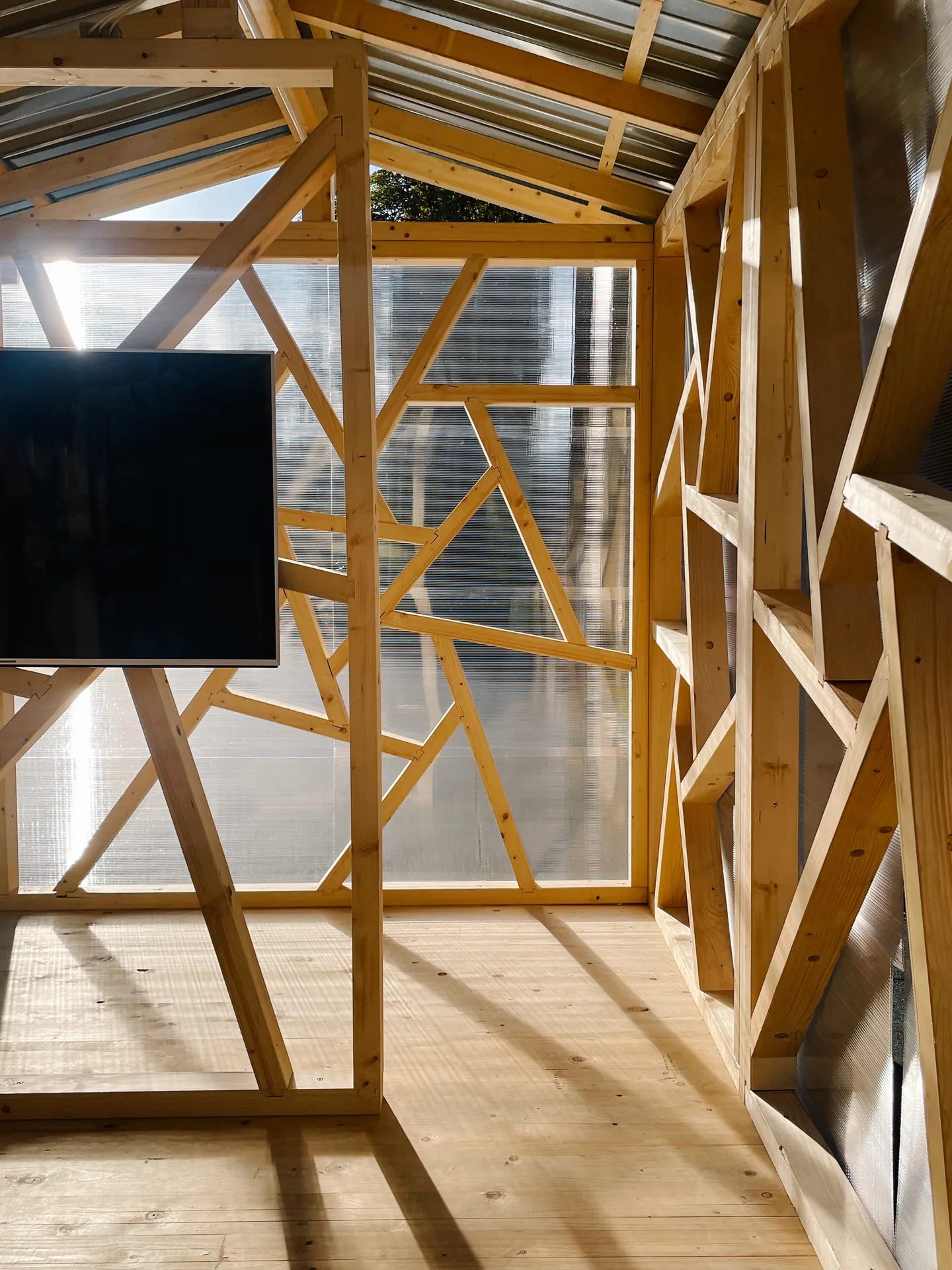
The demonstrator showcases an innovative approach to the resource-efficient use of wood. As part of the project, a novel robotic manufacturing system was developed that can not only process large components but also precisely grasp, machine, and automatically assemble smaller wooden elements. The technology offers particular potential for processing low-grade, reused, or irregularly shaped pieces of wood, which until now have often had limited uses.
The manufacturing process is complemented by AI-supported planning methods. A specially developed process arranges pieces of wood of varying lengths in such a way that waste is minimized and the available material is used as efficiently as possible. The resulting load-bearing structures are material-efficient, high-performance, and open up new possibilities for circular construction methods.
The NEW bauhaus Festival deliberately builds on the interdisciplinary spirit of the historic Bauhaus and serves as a platform for exchange between research, industry, and professional practice. With more than 400 participants, as well as numerous expert presentations, exhibitions, and demonstrations, Weimar became a hub for future-oriented topics in construction for two days.
Participation offered the DTC team the opportunity to present current research findings to an international audience of experts and to engage in dialogue with representatives from academia, industry, and politics about the future of digital and sustainable construction. In doing so, the Technical University of Applied Sciences Augsburg made a visible contribution to a key debate in the construction industry: How can digital technologies and resource-efficient construction methods be meaningfully combined?