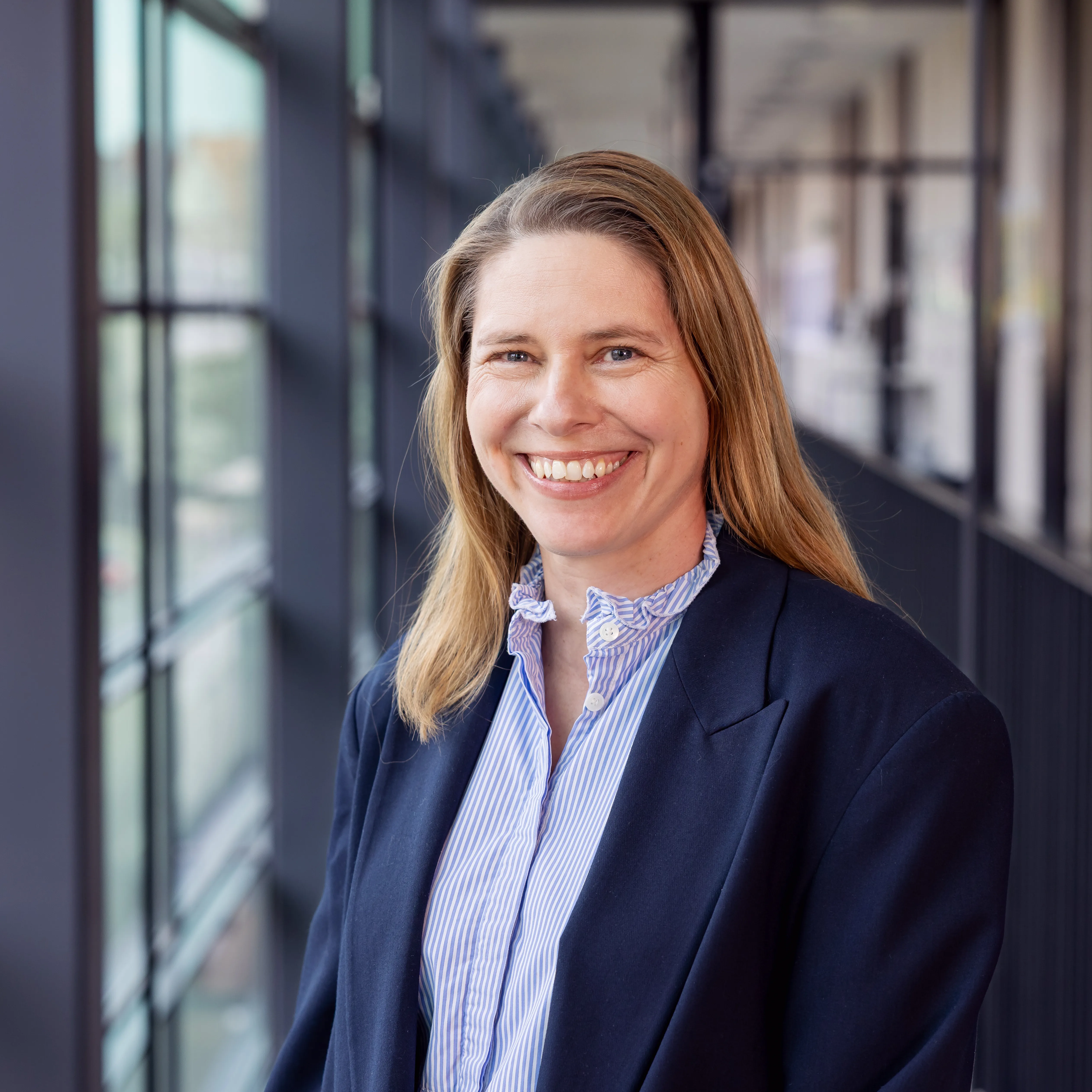
Prof. Dr. Simone Kubowitsch
Institution
School of BusinessFunction
- Dean of Studies School of Business
- Director of Studies International Master of Research and Innovation (M.Sc.)
Room
W 2.05Degree Programs
International Master of Research and Innovation (M.Sc.)Sustainability Management (M.A.)Business Psychology (B.Sc.)Phone
+49 821 5586 2935- Human Resources Psychology
- Human-AI Interaction
- Psychophysiology & Applied Neuroscience
- Digital Health
- Teamwork in Virtual Reality
Prof. Dr. Simone Kubowitsch has been teaching and conducting research since 2021 as a professor of industrial and organizational psychology at Augsburg University of Applied Sciences, specializing in assessment, human resource development, and workplace health. Her research focuses on human experience and behavior in various contexts. Central to her work is the question of how health and well-being, as well as individual and collective capacity for action and performance, can be maintained and promoted. In addition, she investigates the effects of digital and AI-supported work environments on mental well-being.
To this end, she uses multimodal data, particularly psychophysiological, biomechanical, linguistic, and interaction-related data. Her work combines basic psychological research with applied method development—particularly in the area of psychophysiological measurement methods—and the design of health-promoting work environments.
| General Psychology: Learning, Motivation, and Emotion | Fundamentals of human learning, motivational processes, and emotional experience; classical and modern learning theories; self-regulation; goal setting; intrinsic and extrinsic motivation; the origins and functions of emotions—with practical applications to work, leadership, and human resource development. |
|---|---|
| Differential Psychology and Diagnostics | Individual differences in personality, intelligence, motivation, and behavior; psychological test theory; diagnostic procedures; quality criteria; judgment and decision-making processes; and the responsible use of psychological diagnostics in personnel selection and human resource development. |
| Test Design & Surveys | Conception and development of psychological tests and standardized surveys; operationalization of constructs; item and scale development; questionnaire design; reliability and validity; sample planning; digital data collection methods; and analysis and assurance of data quality. |
| Mental Health in the Workplace | Models and factors influencing mental health in the workplace; job demands and resources; stress, recovery, burnout, well-being, and resilience; risk assessment of psychological strain; and evidence-based approaches to prevention and health-promoting workplace design. |
| Sustainable Human Resource Management | Sustainable design of human resources processes throughout the employee life cycle; long-term employability; health, competency development, participation, and social responsibility; sustainable recruitment, leadership, and retention; and the contribution of human resources management to digital, environmental, and societal transformation. |
| Team Functioning | This line of research focuses on how teams can collaborate effectively and maintain a healthy work environment under digital, virtual, and technology-supported working conditions. In particular, the research examines communication, coordination, trust, psychological safety, team flow, and team resilience, as well as their significance for adaptability and performance. In the DaTeam-VR research project, these processes are analyzed in virtual work environments using multimodal and time-dynamic methods and translated into practical approaches for promoting healthy teamwork. |
|---|---|
| Well-being in Digital and AI-Supported Work Contexts | This line of research examines how digital technologies and AI systems influence employees’ experiences and behaviors. The focus is on psychological well-being, technostress, autonomy, and the fulfillment of basic psychological needs, as well as the question of under what conditions technological support acts as a resource or a burden. The findings will be used to design digital work environments that are people-centered and promote health. |
| Character Strengths in Higher Education and the Workplace | This research focus examines the significance of individual character strengths for professional and academic experiences. In the workplace context, research explores how strength-based and AI-supported reflection formats can promote the use of personal strengths as well as well-being and work engagement. In the higher education context, the focus is on the fit between students’ character strengths and the requirement profiles of their desired professions, as well as their relationship to career adaptability, self-concept, well-being, and satisfaction with their studies. |
| Individual and Team-Based Stress Measurement | Research on stress measurement focuses on the differentiated assessment of psychological and physical reactions in work and performance situations. To this end, subjective assessments are combined with psychophysiological, linguistic, interaction-related, and biomechanical data. Particular emphasis is placed on the development of multimodal measurement approaches that can map stress and strain processes as realistically and comprehensively as possible. |
| An Integrated Approach Combining Psychology and Biomechanics | This line of research combines psychological analyses of perception, stress, and behavior with biomechanical investigations of physical strain and movement. As a result, mental and physical processes are not considered in isolation but rather in terms of their mutual interaction. This integrated perspective enables a deeper understanding of performance, fatigue, and health risks and forms the basis for evidence-based prevention and intervention strategies. |
| Promoting Sustainability Competencies | The TexTiles project investigates how sustainable thinking and action can be promoted using the textile industry as a case study. The focus is on systems thinking, shifting perspectives, the ability to reflect, and managing conflicting goals. Innovative teaching and learning formats support the transfer of these concepts into academic studies and professional practice. |
| Selected Publications | |
|---|---|
| Scientific Publications | |
| 2026 | Watermann, L., Lermer, E., & Kubowitsch, S. (2026). From AI use to positive functioning: The roles of trust and need satisfaction. Group. Interaction. Organization. Journal of Applied Organizational Psychology (GIO), 1–13. |
| 2025 | Hogh, N., Braun, J., Watermann, L., & Kubowitsch, S. (2025). I Don’t Buy It! A Critical Review of the Research on Factors Influencing Sustainable Fashion Buying Behavior. Sustainability, 17(9). |
| Watermann, L., Kubowitsch, S., & Lermer, E. (2025). AI and work design: A positive psychology approach to employee well-being. Group Interaction Organization: Journal of Applied Organizational Psychology (GIO). | |
| 2024 | Braun, J., Hogh, N., & Kubowitsch, S. (2024). Evaluating team workload through physiological synchrony: An exploratory study using MdRQA data to assess teams in action. In Proceedings of the 7th European Conference on Industrial Engineering and Operations Management (IEOM). IEOM Society International. |
| 2023 | Auer, S., Kubowitsch, S., & Dendorfer, S. (2023). Combined influence of psychological and biomechanical factors on muscular loads in soccer: A new approach for the prevention of muscle injuries. Orthopadie (Heidelberg, Germany), 52(11), 876. |
| 2021 | Auer, S., Kubowitsch, S., Süß, F., Renkawitz, T., Krutsch, W., & Dendorfer, S. (2021). Mental stress reduces performance and alters musculoskeletal loading in soccer-related movements. Science and Medicine in Soccer, 5(4), 323–329. |
| Scheer, C., Kubowitsch, S., Dendorfer, S., & Jansen, P. (2021). Happy enough to relax? How positive and negative emotions activate different muscular regions in the back—an exploratory study. Frontiers in Psychology, 12, 511746. | |
| Book chapters | |
| 2025 | Kubowitsch, S., & Watermann, L. (2025). People Analytics. In L. von Rosenstiel, E. Regnet, & M. E. Domsch (Eds.), Leading Employees (9th ed., pp. 589–599). Haufe. |
| Presentations and Conference Papers | |
| 2026 | Watermann, L., Braun, J., Hogh, N., & Kubowitsch, S. (2026). Competencies for Tomorrow’s Teamwork: A Hybrid, Data-Driven Approach to Team Diagnostics. Poster presentation at the 29th Annual Conference of the Society for Applied Business Psychology (GWPs), January 26–28, Gelsenkirchen, Germany. |
| Hatfield, S., Watermann, L., Kubowitsch, S., Hommes, J., & Binder-Knott, H. (2026). Teaching sustainable textile production through play: Development and evaluation of an interactive museum exhibit. Talk at the 29th Annual Conference of the Society for Applied Business Psychology (GWPs), January 26–28, Gelsenkirchen, Germany. | |
| Watermann, L., Weber, J., Lermer, E., & Kubowitsch, S. (2026). The Role of AI in the Workplace: Consequences for Mental Well-Being and the Fulfillment of Basic Needs. Presentation at the ISQOLS 2026 Winter Virtual Conference, January 29–20. | |
| 2025 | Watermann, L., Hogh, N., Braun, J., & Kubowitsch, S. (2025). Development of Future-Oriented Team Diagnostics: An Interdisciplinary Approach to Identifying Success-Relevant Team Processes in Virtual Reality Environments. Poster presentation at the 85th Annual Meeting of the Academy of Management, July 25–29, Copenhagen, Denmark. |
| Watermann, L. & Kubowitsch, S. (2025). Mitigating Technostress in AI-Driven Workplaces: The Role of Digital Skills and Self-Efficacy. Talk at the 22nd EAWOP Congress, May 21–24, Prague, Czech Republic. Shortlisted for the Best Oral Presentation Award. | |
| Watermann, L., Hogh, N., Braun, J., & Kubowitsch, S. (2025). The Role of Perceived Consumer Effectiveness and Information in Sustainable Clothing Consumption. Presentation at the 22nd EAWOP Congress, May 21–24, Prague, Czech Republic. | |
| 2024 | Kubowitsch, S. & Cocron, P. (2024). The Potential of Integrated Workload Measures in Production. Presentation at the 7th European Conference on Industrial Engineering and Operations Management, Augsburg, Germany. |
| 2019 | Kubowitsch, S., Suess, F., Jansen, P., & Dendorfer, S. (2019). Effect of dual tasking on muscular imbalances. Paper presented at the 25th Congress of the European Society of Biomechanics, Vienna, Austria. |
| 2018 | Kubowitsch, S., Suess, F., Jansen, P., & Dendorfer, S. (2018). Comparison of dynamic muscular imbalances in patients with back pain and healthy controls. Poster presented at the 8th World Congress of Biomechanics, Dublin, Ireland. |
- Shortlist for the 2023 Teaching Award from Augsburg University of Applied Sciences in the "Large-Scale Event" category