IT-4-Education
Through hands-on exercises with microcontrollers, the project teaches students the fundamentals of computer engineering in a fun and engaging way. A freely programmable and expandable robotic car provides a practical platform for students to independently explore programming and robotics.

IT-4-Education
Degree Program
ET - Discontinued
Project Description
This car, developed from the ground up, encourages students to learn programming and is perfectly designed, equipped, and expandable for that purpose.
People Involved
Student group: Alexander Beck, Florian Hieber, Claus Janicher, Sebastian Klement, Christian Zellinger
Advisor: Prof. Dr.-Ing. Christoph Zeuke
Course
Technical Project Course, Computer Engineering
Program, Faculty of Electrical Engineering and Computer Science
Duration
Winter Semester 2022/23
Requirements
Functional Requirements
The robot can:
- detect changes in contrast using infrared sensors.
- turn its headlights on and off.
- use the RGB LEDs as turn signals.
- steer in a specific direction from its starting position using the compass module.
- use the OLED display as an identifier and for displaying information.
- Determine distances in all four directions using time-of-flight sensors.
- Output data and be controlled via a self-hosted network and the server hosted within it.
Non-functional Requirements
The robot should be able to operate for as long as possible on a single battery charge, and no system crashes should occur. The libraries should be written as simply and clearly as possible.
Requirements for Commissioning and Operation
Commissioning should be straightforward and require minimal wait times. As soon as the standard program is loaded onto the ESP, the robot should be able to use all implemented functions.
Quality Requirements
The robot’s housing should absorb the impact of collisions even at higher speeds to the extent that no permanent damage occurs to the motors, circuit board, battery, or electronics. In addition, the battery capacity should be sufficient to perform multiple program tests. Therefore, a battery runtime of over ten minutes must be achieved.
Use Cases
The vehicle is being developed with the potential to be used as a kit in schools. The goal is to provide students with a simple and successful introduction to the world of IT.
User Stories
The students would like to:
- understand the program’s functions.
- modify code on their own.
- experience quick success.
- program on their own without extensive guidance from a teacher.
- be able to replace or expand sensors.
- Be able to easily replace broken parts.
- Wire and solder sensors.
- Understand the functions of the corresponding sensors.
- Be able to 3D-print replacement parts.
- Understand electrical components.
- Understand the accompanying instructions.
- Be able to continue operating the vehicle even after collisions.
- Solve various tasks.
- Be able to operate the vehicle with minimal effort.
The teachers would like to:
- maintain an overview of the functions.
- understand the accompanying instructions.
- understand the electrical components.
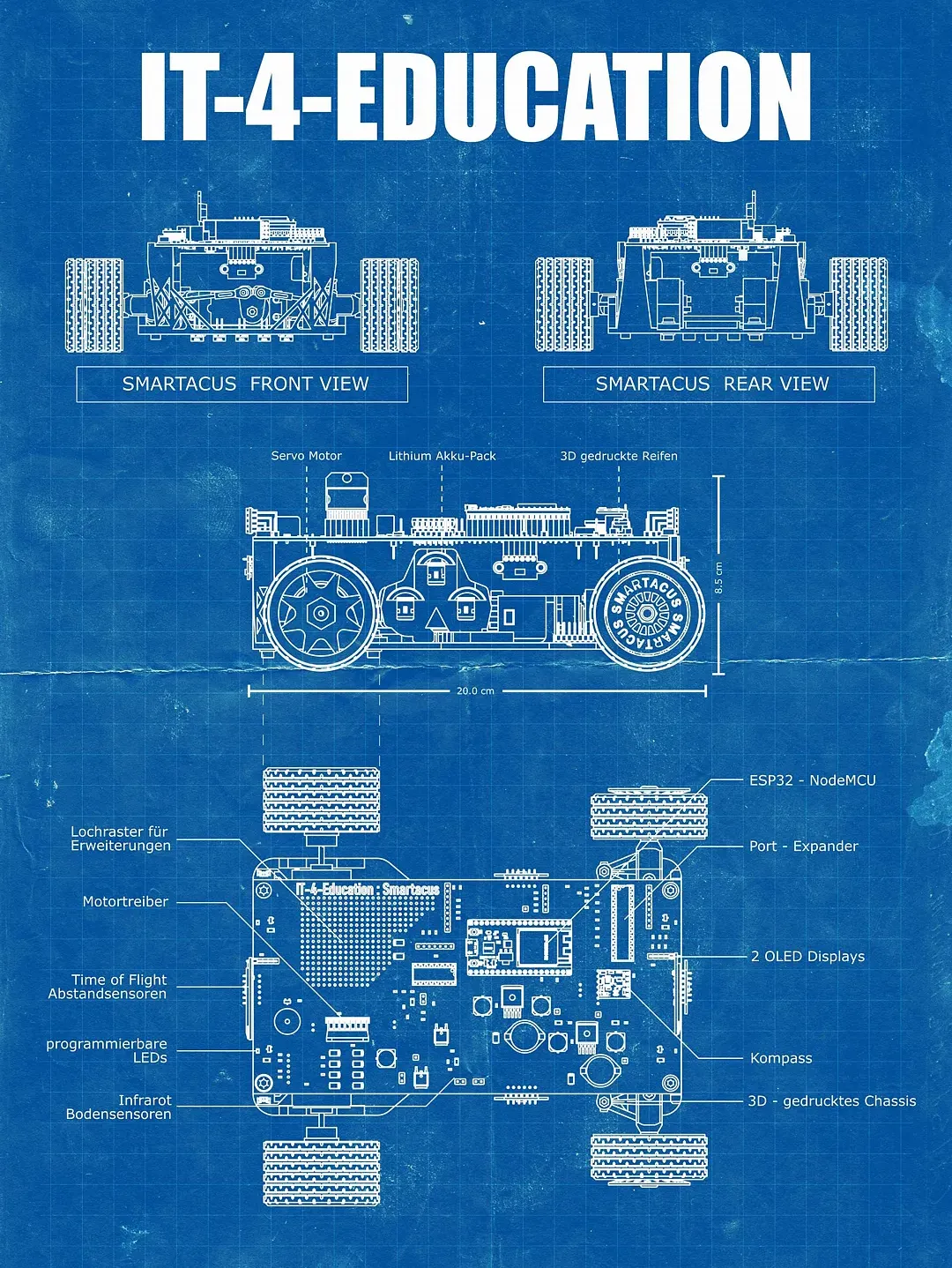
Implementation
Comprehensive website with assembly and programming instructions
Freely programmable robot car for students.
Developed from the ground up, this car encourages students to learn programming and is perfectly designed, equipped, and expandable for that purpose.
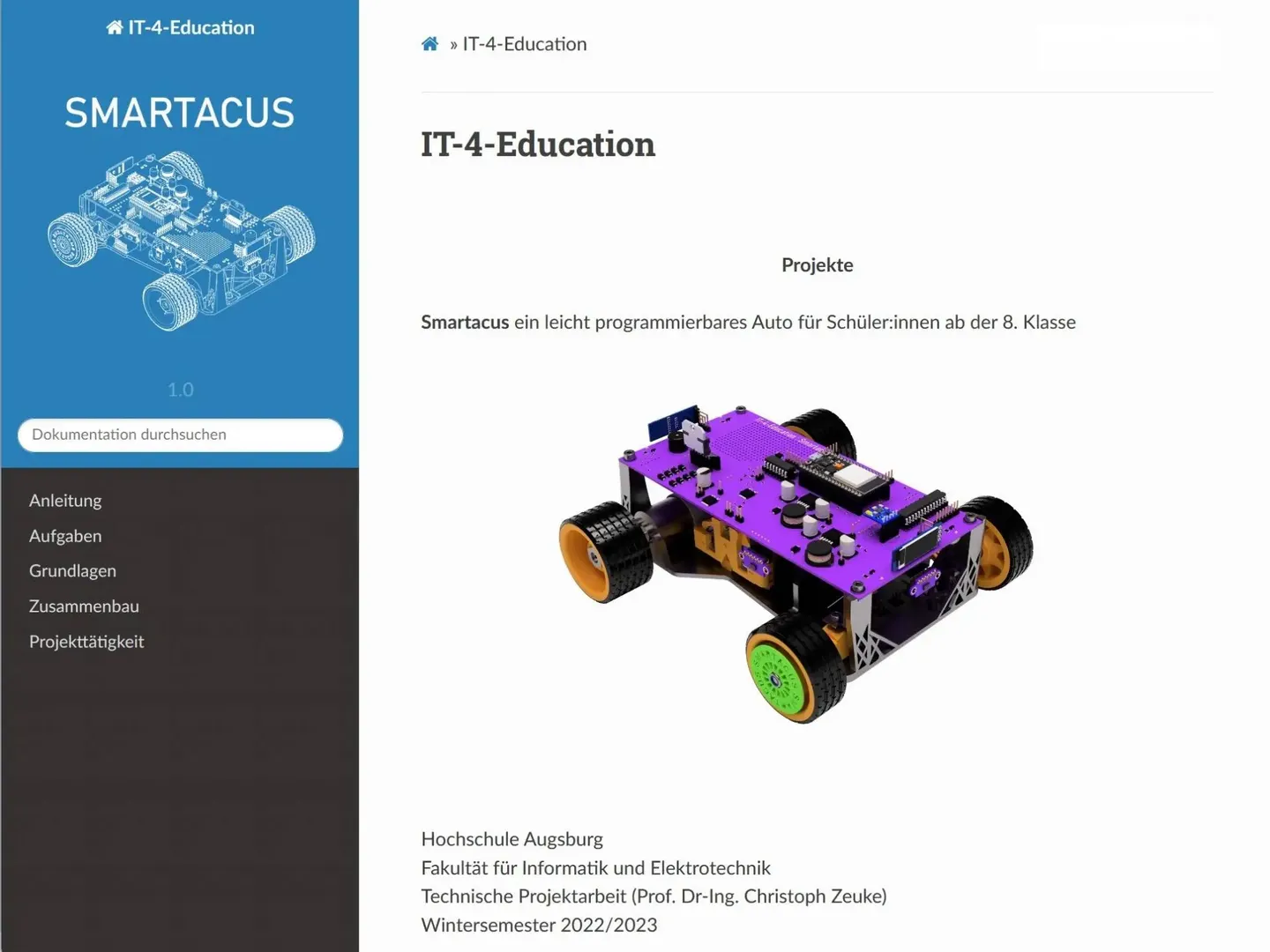
Uses
Possibilities
- Open Source Hardware
- Open Source Software
- Detailed instructions for building the components and assembling the device yourself
- Simple steps to get started with software programming
- Endless possibilities for expansion