Lukas Wenger reports on his dual-track degree program at KUKA
Hi Lukas, thank you very much for taking the time to talk with us. You completed a dual study program at the Technical University of Applied Sciences Augsburg, which means you studied mechanical engineering while also completing an apprenticeship as an industrial mechanic at KUKA. Why did you choose this type of program?
Lukas Wenger: My schooling was already practically oriented—after middle school, I went on to a vocational high school (FOS). That’s why it became clear to me early on that a practical focus was very important to me, even in college. This was reinforced by the fact that I grew up on a farm and was interested in vocational training.
From the very beginning, the dual study program was clearly the “ultimate choice” for me, since, in my view, it’s a unique opportunity to acquire extensive theoretical knowledge while simultaneously gaining in-depth practical insight. The vocational training and the theoretical foundation from my studies complement each other perfectly and were therefore a great asset to me.
In your opinion, what are the advantages of the dual degree program in mechanical engineering at THA?
Lukas Wenger: As a dual-track student, I can make connections to real-world practice and thus more easily develop a good product. Through my vocational training, I’ve gained an understanding of manufacturing and assembly; I know how materials behave, see the steps involved in joining them, and am familiar with manufacturing processes. This allows me to ensure, right from the development stage, that the product not only meets customer requirements but can also be manufactured efficiently and cost-effectively.
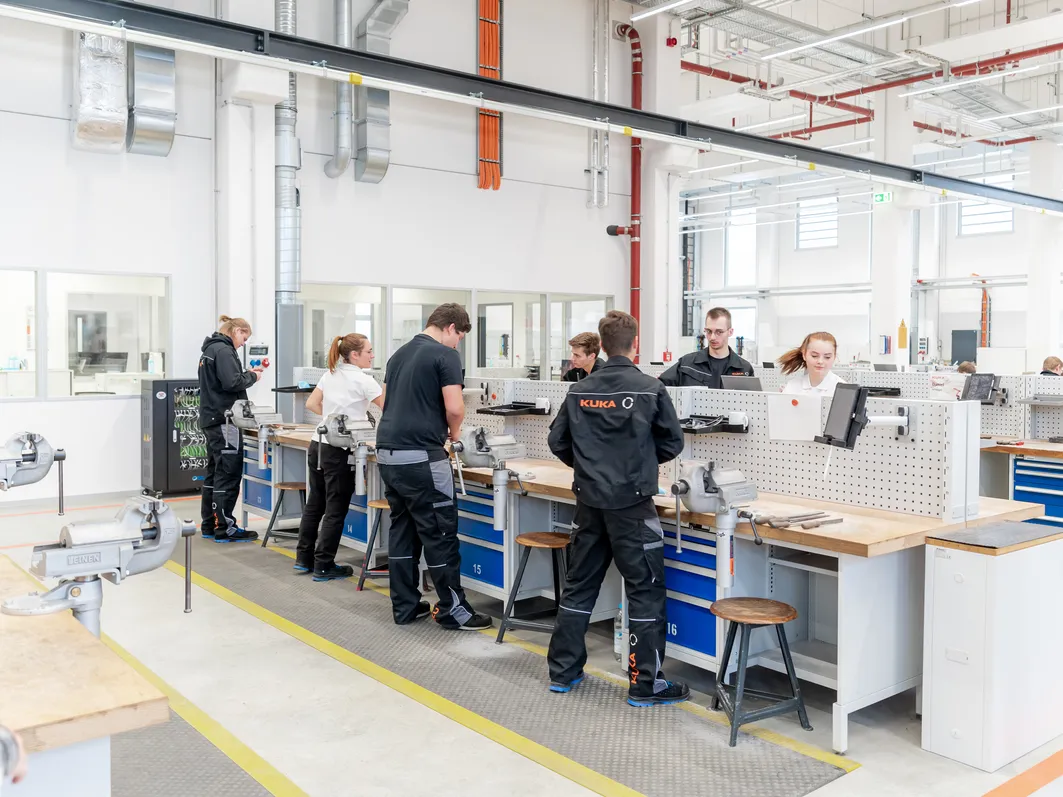
During my foundational year—that is, the first year of the dual study program—I learned how to work with metals at KUKA’s training workshop: filing, milling, turning, and welding. This allowed me to see firsthand how products are manufactured and how materials behave during the process. During my studies, I then learned why that is the case. This allowed me to gain a theoretical understanding of my practical experiences through my coursework.
It’s also very convenient that the combined program takes place entirely in one city—or rather, in one location—with KUKA as the company, the THA, and the vocational school. It’s all in Augsburg.
What does the combination of vocational training and university studies look like in practice? Can you outline a typical semester schedule?
Lukas Wenger: The combined program consists of vocational training and a bachelor’s degree program over 4.5 years. Vocational training begins in the first year, and at the end of the first year of apprenticeship, there’s the final exam, Part 1. This accounts for 40% of the final grade for the vocational training. During my first year of apprenticeship, I learned all the fundamentals of the trade, including all the manufacturing processes. I then began my university studies in the second year.
The semester consists of “normal” daily life at the university, just like for all students. The break after exams is spent at the company. That means I was at the university from the first day of classes until the last day of exams. On the first day after the final exam, I returned to the company—unless you take time off.
During your time at the company, you rotate through various departments, spending four to five weeks in each. After the fourth semester, you take Part 2 of the final exam, thereby completing your vocational training. Following that, you gain your first insights into engineering-related work through the internship semester. You’ll engage in this type of work a second time while writing your bachelor’s thesis. This thesis is written at the company on a topic relevant to your degree program. As soon as you’ve completed your final exams and submitted your bachelor’s thesis, your bachelor’s degree program—and thus the entire dual degree program—is complete.
What challenges did you face both at the company and at the university?
Lukas Wenger: That’s not an easy question to answer. There’s a great network among the trainees and students at KUKA. Knowledge and experiences are shared across both the university and the company.
One aspect of the dual study program is that you’re contractually bound to one company for the entire duration. As a result, you get to know “only” one corporate culture. However, I don’t see this as a major disadvantage, since there were many areas at KUKA for me to explore, and KUKA always supported me in gaining a variety of experiences. For example, the combined study program also allows for a semester abroad or working for KUKA overseas.
How did you manage to balance your training, studies, and free time?
Lukas Wenger: The balance works out relatively well. During exam periods, it’s important to focus entirely on that for about four weeks, but that’s also the case with “regular” studies. The good thing is that you’re always focused on one thing at a time—whether that’s studying during the semester or working at the company during semester breaks. Things are organized in order, and during semester breaks, dual-track students at KUKA get 30 days of vacation each year, so there’s still time for personal life.
For example, I was actively involved in clubs even while pursuing my dual degree program and earned an additional qualification through the Bavarian Elite Academy. KUKA supported me by giving me time off so that I could complete this qualification.
What helped you successfully complete your dual degree program?
Lukas Wenger: The company and the networks you build help support both your studies and your training. I also receive help, support, and understanding from family and friends during stressful periods. During exam periods, other things have to take a back seat—and my friends and family understand that.
How were you able to apply what you learned in your studies at KUKA, your training company?
Lukas Wenger: It works both ways—practical experience helps you grasp the theory, and the theory supports you in practice. For example, when designing screws or fasteners. Thanks to my studies, I can better assess the properties of a screw. I know the materials and the fundamentals. Theory is the foundation for the job, especially when it comes to engineering-related tasks at the company.
What advice do you have for people interested in a dual degree program in mechanical engineering?
Lukas Wenger: Start researching early! Make connections and decide what’s right for you—an apprenticeship, a degree program, or even both? At many companies, the application period for a dual degree program begins as early as one year before high school graduation. Student internships really helped me figure out my path. One tip is to check out the “Hochschule Dual” website—you’ll find a lot of information there.
Personal contact is very important—for example, at career fairs where you can talk to company representatives, apprentices, and students. In addition, the Employment Agency in Augsburg organizes a “speed dating” event for dual study programs, where interested students can get to know different companies.
One last thing: Would you recommend a dual study program, and what are your fondest memories from that time?
Lukas Wenger: I can definitely recommend the combined degree program, and I’d do it exactly the same way again: a mechanical engineering degree combined with vocational training. If you want to become an engineer, it’s a huge advantage to be able to combine theory and practice. That’s why I decided to pursue a dual master’s program after completing my bachelor’s dual study program.
I have many fond memories of my first year of apprenticeship in the training workshop, the great surroundings, and the atmosphere at the company. At the same time, I also made friends while studying at THA and we spent many wonderful hours together. The variety, in particular, is what made those 4.5 years so exciting for me.
One really exciting project was the relocation of a matrix cell.
[A Matrix cell is a highly flexible production system. It was moved from one hall to another—that is, completely dismantled and reassembled.]
The two of us led the project. We had great points of contact and carried out the relocation with nine fellow trainees. It was an opportunity to gain insight into a large-scale project and to take on leadership responsibilities.
4.5 years sounds like a long time, but the time flies by.
More on this topic
: Click here for the interview with KUKA’s training supervisor, Manfred Schußmann