
NuCollect – The Collection System of the Future
Grant Period: February 1, 2025–January 31, 2027
Project Description
Current Situation
Consumption and waste volumes of clothing and home textiles are steadily rising in Germany, while recycling has so far consisted primarily of downcycling. Of the approximately 1 to 1.2 million metric tons of textiles collected each year, only about 27 percent are recycled. Although a separate collection requirement for municipalities has been in effect since January 2025, the existing collection system using public containers dates back to the 1990s: textiles are mixed together in these containers and are often soiled, which makes high-quality recycling difficult.
Project Goals
To counteract this, the project team is developing a comprehensive collection and sorting system for used textiles that will significantly improve the quality of the recovered recycled fibers. This will be made possible by pre-sorted drop-off, which will also include non-apparel textiles in the future. The goal is to achieve significantly higher recycling rates than today through targeted presorting.
Approach
To this end, the project team first analyzes and optimizes existing sorting practices and, building on this, develops a new system that pre-sorts textiles by material, color, and structure already at the time of collection. It takes into account both manufacturer-specific and manufacturer-independent collection systems and actively involves citizens by having them presort their textiles at home (into the categories ReUse, Recycling, or residual waste).
Project Consortium
Project Manager / Contact Person: Nicole Hühn, nicole.huehn@ita-augsburg.de
Other Team Members: Svenja Jahn
Project Partners: aktion hoffnung (Hilfe für die Mission GmbH), TEXAID Deutschland GmbH



Funding
Grant Program: DATIpilot
Funding Agency: Federal Ministry of Research, Technology, and Space (BMFTR), as part of the Circular Textiles (CirTex) Innovation Community

Add-on Module: NuCollect Engage
The NuCollect Engage participation module expands NuCollect with a targeted engagement approach: Citizens, municipalities, and waste collection and disposal operators are involved as co-designers to improve the feasibility, participation, applicability, and inclusivity of the collection system. The project is currently focused on the Augsburg region, with the option for geographic expansion.
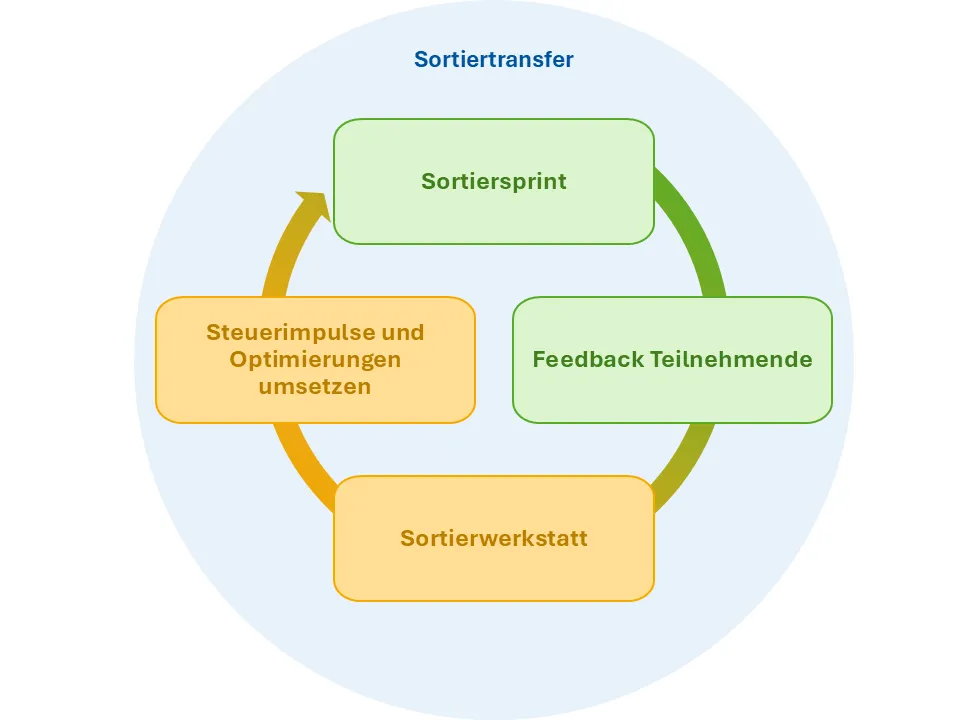
Implementation takes place in three sequential steps: First, so-called “sorting sprints” in real-world experiments test a digital decision-making tool (“Textile Check,” see above), in which participants pre-sort their used textiles at home into reuse, recycling, and residual waste—their feedback on the application is immediately incorporated into further development. In parallel, sorting workshops bring participants together in dialogue and co-creation formats to jointly improve system design and communication.
The insights gained ultimately lead to the “sorting transfer”: The tested dual collection system—comprising collection bags and the existing container system—is transitioned from the test phase into a permanent service that will remain available to residents even after the project has ended. Sorting sprints and workshops run in iterative cycles, allowing insights from practical experience to be continuously incorporated.
Funding
Project Manager / Contact Person: Svenja Jahn, svenja.jahn@ita-augsburg.de
Funding Period: May 1, 2026–February 28, 2027
Grant ID: 03DPC0312
Funding Agency: German Aerospace Center (DLR)