CirTex Projects

As part of the Circular Textiles Innovation Community, funding from the BMFTR is currently supporting 10 community projects addressing various aspects of the circular textile economy, as well as a cross-cutting project that investigates the transfer of knowledge regarding the research findings emerging from the community.

Community Projects

The following community projects are funded through CirTex:
SIRUp Project Logo

SIRUp

The SIRUp (Social Innovations in Re- and Upcycling) project aims to embed technological innovations in the field of re- and upcycling within social contexts and to expand upon them through social innovations. The research team seeks to understand which social factors promote the acceptance, use, and dissemination of re- and upcycled textiles and how appropriate communication strategies and business models can be developed. In this way, SIRUp contributes to the overarching goal of the Circular Textiles innovation community: to establish a holistic circular textile economy.

"ReUse" or "Recycling" stickers that can be affixed to trash bags for the preliminary sorting of used textiles.

NuCollect

The NuCollect project team is developing an innovative system for collecting and sorting used textiles that actively involves citizens. In Germany, consumption and waste volumes of clothing and home textiles are rising sharply, while current recycling practices consist primarily of downcycling. As a result, more than 500,000 metric tons of textiles are lost annually that could be put to higher-value use. To conserve resources, the researchers at NuCollect aim to strengthen reuse and recycling streams and increase the recycling rate. This will lay the foundation for a steady supply of secondary raw materials. Efficient pre-sorting by consumers can make a decisive contribution here.

Textile Recycling Catalog (AI Visualization)

TexReKat

The transformation of the textile industry toward truly circular systems requires transparent and reliable information about products, materials, and realistically achievable recycling rates. The TexReKat (Textile Circularity Catalog) research project is creating, for the first time, a scientifically sound, publicly accessible catalog of recyclable textile products for industry, research, and policymakers. CirTex community members are actively involved in data collection, validation, and further development.

The elastomer being developed and tested in the RElastan project comes in the form of sheets, yarn, and granules.

RElastan

Whether it’s sportswear, casual wear, or medical textiles: nothing works in the textile industry without elasticity. But the elastane fibers most commonly used for this purpose are virtually impossible to recycle—they are difficult to separate from other fibers in blended textiles. The RElastan project team is developing elastic yarns and textiles based on thermoplastic copolyester elastomers (TPC). These offer the same stretch as conventional elastane but can be melt-spun and later recycled thermomechanically—and are also compatible with common polyesters such as PET, which makes it easier to process them in existing recycling facilities. As a result, they could serve as an alternative to the elastanes commonly used today. This is an important step toward truly circular solutions in the textile industry.

Screenshot of the CircSim Circulation Simulator

CircSim

CircSim (Circular Economy Simulator) illustrates how the circular economy in the textile sector works and what concrete benefits it offers for the environment, society, and the economy. The goal of the project is to provide easy access to well-founded, scientifically sound data—presented in an understandable way for policymakers, the business community, academia, schools, and civil society. At the heart of the project is an interactive circular economy simulator that demonstrates how different decisions throughout the entire life cycle of textiles interact. Users can explore and compare various decision paths.

KI-generiert: Wissensplattform sammelt und bereitet Wissen auf.

TexWi

The TexWi project (Effective Knowledge Transfer on Sustainable Textiles & the Circular Economy) explores and tests innovative ways to effectively convey knowledge about sustainable textile production, textile use, and other consumption models to various target groups. The starting point is the challenge that existing knowledge about the environmental and social impacts of the textile industry has so far had only a limited effect on changing behavior. TexWi addresses this issue directly and examines new educational and communication formats designed to improve this transfer of knowledge.

AdobeStock_1452300303_Zhuxin

MAXIM

Producing clothing, preventing clothing waste, and still operating sustainably—for a long time, this was seen as an irreconcilable conflict with no solution. In the MAXIM project (Solutions for Minimizing Clothing Waste for MAXIMum Benefit to All Stakeholders), an interdisciplinary project team is developing business models that create environmental, economic, and social benefits for all stakeholders involved. To this end, the project team is examining influencing factors along the textile value chain and deriving practical visions and recommendations for action from these findings. The focus is on a “both-and” approach: reducing consumption and waste while simultaneously fostering economically viable innovations for sustainable textiles.

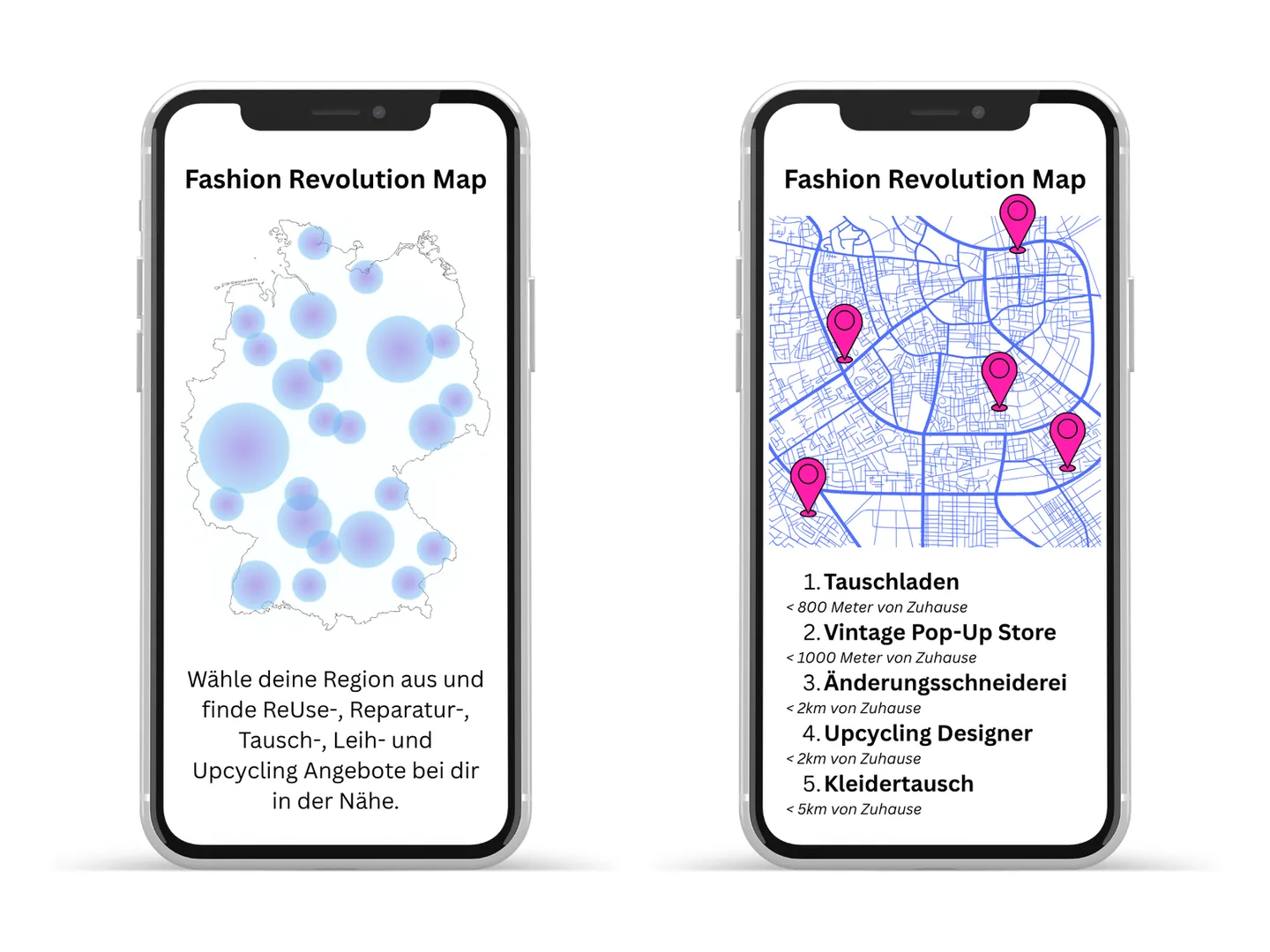
Fashion Revolution Map on your smartphone.

FRITA

Alternatives to buying new—such as renting, repairing, upcycling, and clothing swaps—do exist, but they are fragmented and barely visible in everyday life. Yet a survey by Fashion Revolution Germany e.V. shows that one in five people in Germany would use reuse services regularly if they had easier access and guidance. This is where the team behind the FRITA project (Fashion Revolution Map—Digital Infrastructure for Circular Textile Consumption Services) comes in. Based on empirical research, the “Fashion Revolution Map” is being developed—a digital platform that highlights, aggregates, and connects circular textile consumption options in Germany. In this way, FRITA helps reduce new purchases and put the EU Textile Strategy into practice.

Grafik zeigt den Life Cycle eines Textils. Hervorgehoben sind "Garn, Fläche und Design/Prototypen", weil das Projekt sich mit diesen Schritten beschäftigt.

KOMMIT

Mechanically recycled yarns hold great potential for the circular textile economy—but processing them into woven textiles presents specific challenges: shorter fibers, fluctuating material properties, and impacts on yarn strength and process stability. This is precisely where the KOMMIT (Cooperation for Materials, Fashion, Innovation, and Transfer) project team comes in, combining design, materials research, and industrial production in a co-creative development process. Under realistic production conditions, this approach yields textile swatches, prototypes, and transferable insights for the use of circular textiles.

Textile Air Loop: Circular Cabin Textiles.

Textile Air Loop

Today, most end-of-life cabin textiles end up in thermal recycling. The TEXTILE AIR LOOP project team is developing and validating—for the first time—a closed-loop system for wool aircraft seat textiles: from collection and recycling to integration into new cabin products. The team is focusing on “Design for Recycling,” developing recyclable seat fabric concepts, and scientifically evaluating material properties—particularly with regard to criteria such as flame resistance and recyclability. Digital material passports also provide transparency regarding material origin and recyclability. The goal is to demonstrate technical feasibility as a basis for future industry standards in the field of “Circular Aviation Interiors”—with the potential for application in rail, bus, and maritime sectors.

Cross-Sector Projects

The following cross-cutting projects are funded through CirTex:

TraCe

To ensure that research findings from the CirTex projects continue to have an impact beyond the project’s duration, appropriate transfer channels and formats are needed. TraCe (Strengthening the Transfer of CirTex Projects) is dedicated to this task: As a “transfer meta-project,” the project team supports the CirTex projects in effectively transferring their results to business, politics, academia, and society. The focus is on the quadruple helix approach, which views transfer not as a consequence but as an integral part of innovation processes. The project team first identifies the transfer needs of the CirTex projects and, building on this, develops support services as well as transferable methods, formats, and tools for transferring scientific findings on circular transformation.

The Circular Textiles Innovation Community is a joint project of:

THA Logo
apsus logo
Textile Research Board Logo
TEXAID Logo
The Circular Textiles innovation community is funded by the Federal Ministry of Research, Technology, and Space as part of the "DATIpilot" program.
"DATIpilot" Program Logo
Logo: "Funded by: Federal Ministry of Research, Technology, and Space"