Damage Prevention in Geotechnical Engineering - Preventing Slope Slides
By analyzing numerous damage cases, performing numerical calculations, and conducting laboratory, field, and large-scale tests, it was possible to describe the mechanisms of water-induced slope failure and identify characteristic soil configurations in which stability problems are likely to occur. Furthermore, procedures and methods for identifying aquifers and potential confined aquifers were developed that can be carried out as part of a site investigation. Building on this, recommendations were formulated for conducting site investigations and, where necessary, additional investigative measures or methods that can be used to identify critical site configurations in advance.


Causes of Slope Failure
When creating cuts or slopes, unexpected landslides or ground failures may occur. If this happens during construction, work must be suspended to investigate the causes and implement subsequent remediation measures. Slope failure can have many causes, but it is often due to an inaccurate assessment of groundwater and stratum water conditions.
In addition, temporarily changing water conditions can also cause secondary effects, such as reduced shear parameters. Incorrect or insufficient consideration of the factors mentioned above during the planning phase can result in design alternatives that lack an adequate level of safety or may even lead to failure.
Taking into account the standard calculation methods for the stability of slopes, the following factors, among others, should be noted as influencing stability:
- direct effects from flowing or stagnant water in water-bearing soil layers, such as pore water pressure, flow pressure, and water accumulation
- indirect effects resulting from the action of water; for example, changes in shear parameters due to the softening of individual soil horizons
These factors affecting the stability of slopes can be further exacerbated by various factors or boundary conditions. In addition to the usual slope parameters such as height and slope angle, the following aspects, among others, should be highlighted:
- Slopes of individual horizons within the slope body toward the slope toe;
- The thickness of low- or highly permeable horizons;
- Soil types with highly variable shear parameters.

Claims Analysis
In order to quantify the significant effects of temporary groundwater or interlayer water on slope stability, numerous failure cases were first examined. The damage cases examined showed that damage frequently occurs in the presence of distinct shear planes, and that failure typically occurs in cohesive, softened zones at stratigraphic boundaries. This indicates not only a temporary flow of water along stratigraphic boundaries with differences in permeability but also a certain duration of water exposure within the slope.
When describing larger stratigraphic packages, field investigations revealed that it is insufficient to use the term “alternating bedding.” Rather, a detailed analysis of the individual stratigraphic units—specifically their extent and dip—is required. In some of the projects selected for this research initiative, this approach made it possible to establish a connection between water flow through cohesive strata and corresponding water seepage from the slope.

Laboratory and Large-Scale Experiments
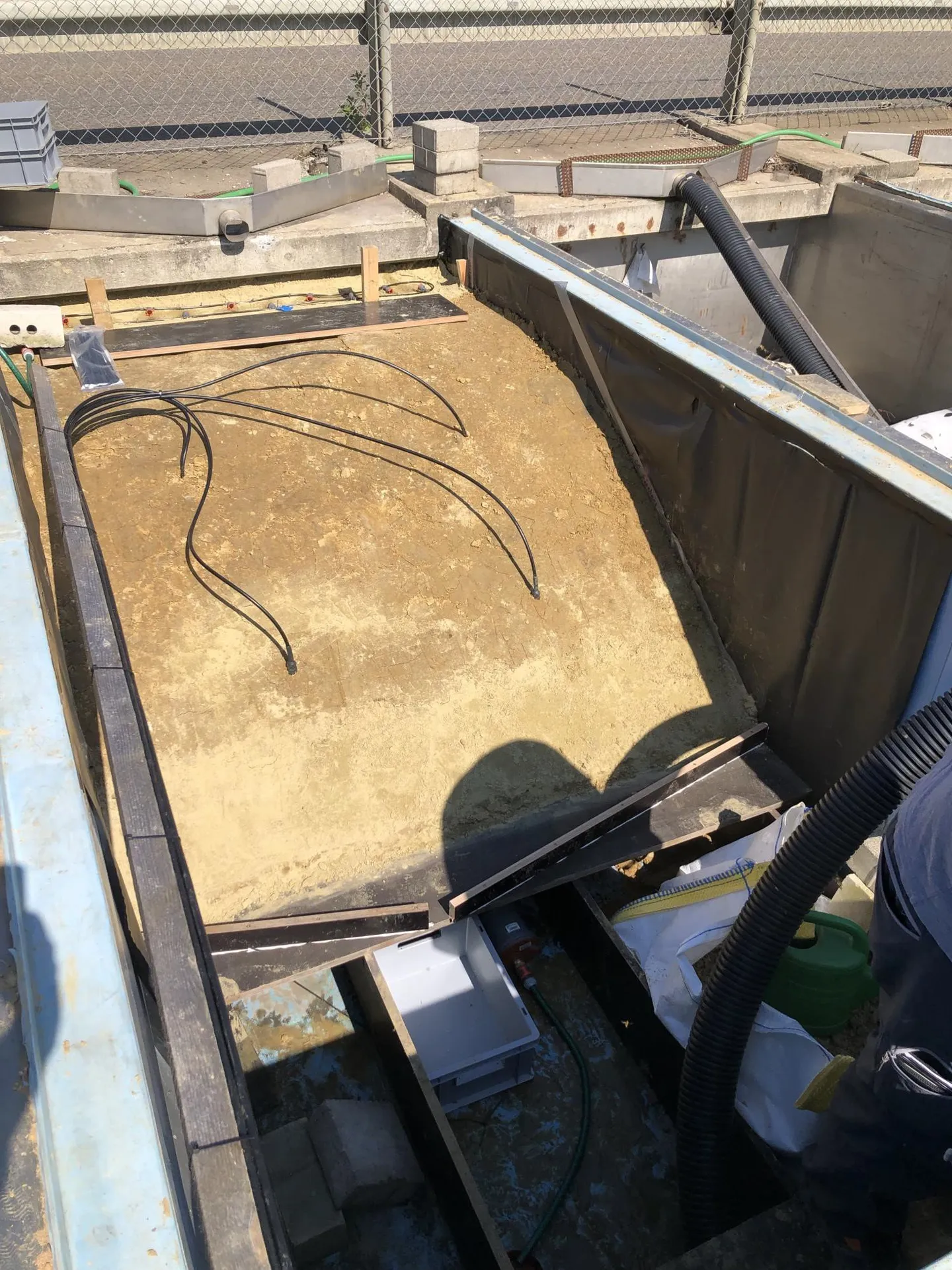
As part of the research project, laboratory, field, and large-scale tests—as well as so-called pilot-plant tests—were conducted. The laboratory tests determined the effects of water saturation on the soil’s shear parameters. The field tests were used to verify the damage mechanisms in selected damage cases. A key component of the research project was the pilot-scale tests conducted at THA. These tests allowed various influencing factors—such as flow through the embankment, water accumulation, and irrigation rate—to be varied on test embankments, and the effects were recorded using various measurement methods.
For example, as a result of a simulated water accumulation in a layer and the resulting increased pressure on the overlying strata, significant moisture penetration with signs of incipient slope failure was observed in some areas. Furthermore, effects such as scouring and erosion were also observed when hydraulic gradients were sufficiently high. Changes in water content—and thus in shear parameters—in cohesive soils and soils adjacent to aquifers were confirmed in both pilot-plant and laboratory tests.
Accompanying numerical calculations
The experiments and damage analyses were supplemented by numerical simulations that modeled the various influences and their resulting effects. With the help of supplementary parameter studies, the influence of individual factors could be examined in detail. For example, numerical calculations that examined various direct and indirect influences from flowing or pooled water in water-bearing layers show that flow through individual layers of a slope leads only to a moderate reduction in stability. Similarly, slight reductions in shear parameters have only a minor effect on the stability of the slope and only become significant when the reductions are substantial.
However, a significant impact on stability occurs when stratum water accumulates in individual horizons—a phenomenon that can be triggered, for example, by an impermeable slope cover—and is further exacerbated when saturation leads to a decrease in shear parameters.
When numerical flow simulations are combined with conventional stability analyses, stability deficiencies can be predicted relatively well, taking into account the presence of interlayer water.


Detection of Temporary Groundwater
In geotechnical engineering, groundwater is typically measured at groundwater monitoring wells or using tensiometers. This method is quite reliable when closed groundwater bodies are present; however, in the case of temporarily occurring stratum water bodies, different requirements generally apply, since the elevation and thickness are usually unknown. As an alternative to direct measurement methods, indirect measurement methods using moisture sensors can be employed.

Indirect measurement methods do not measure the water itself, but rather water-dependent material properties, and require calibration to establish a functional relationship between the measured signal and the water content. The microwave method is considered a suitable technique. The use of microwave probes in the context of site investigation currently appears to be possible only to a limited extent due to the configuration of the measurement setup and the necessary modifications. However, the method shows great potential for detecting changes in water content in the subsoil. Provided that the measurement technology is further developed for use in geotechnical investigations, index measurements or time series tracking changes in water content would be readily feasible and could provide evidence of temporarily water-bearing layers.
Recommendations for Action in Practice
Based on the findings, recommendations for exploration were formulated to identify critical ground conditions. These primarily involve aspects such as a detailed examination of alternating strata, the performance of large-diameter core drilling, investigations into the variability of the rock, and an assessment of the risk of flow. Recommendations were also developed that identify key aspects to be considered during the planning phase. In particular, the recommendations of the geotechnical report must be carefully evaluated. The results of the stability calculations must be integrated into the geotechnical report. The stability calculations must account for pore water pressure lines in potential groundwater horizons; where necessary, variation calculations may be required.
Concluding Remarks
This short article is based on portions of the research project commissioned by the Federal Ministry of Digital and Transportation, represented by the Federal Highway Research Institute, under project number FE 05.0195/2016/MGB.
Sources:
DENNE, FESTAG, GATTERMANN (2023): FE 05.0195/2016/MGB Influence of Temporarily Occurring Groundwater on the Stability of Road Cut Slopes; Report on the research project commissioned by the Federal Ministry of Transport and Digital Infrastructure (BMVI), represented by the Federal Highway Research Institute (BASt).
Contact: