Social Work (B.A.)
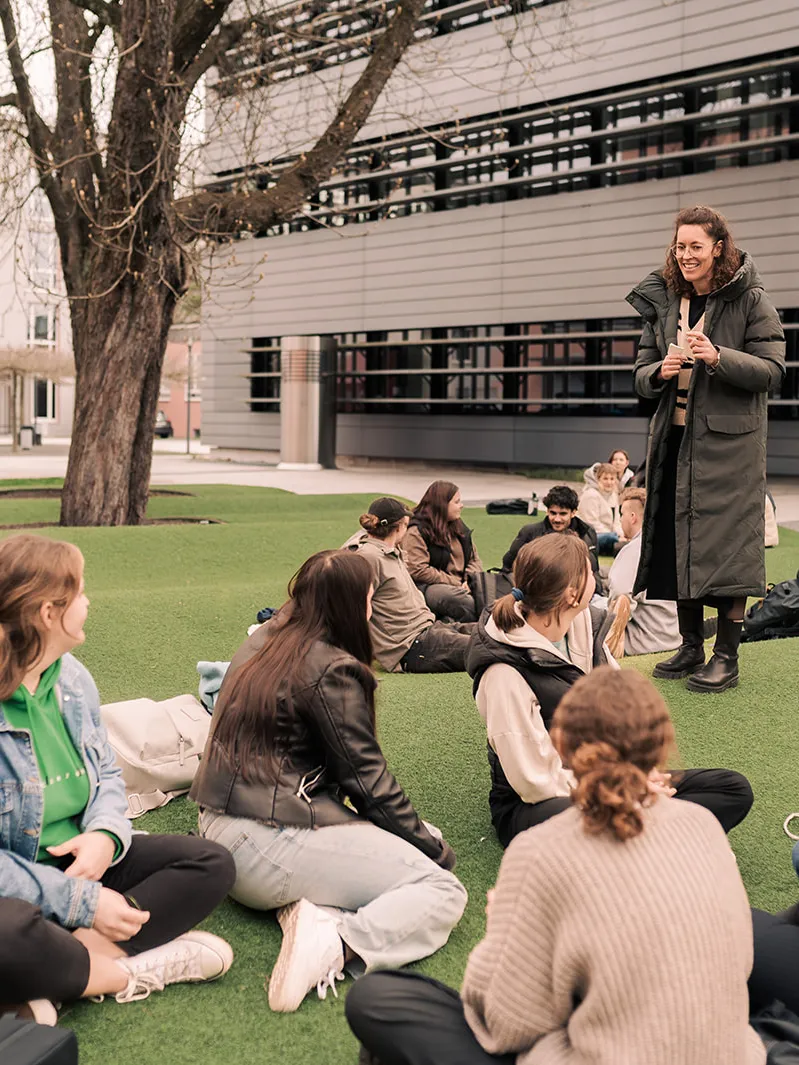

Social work? Social work!
Are you interested in supporting people facing challenging life situations? Do you want to advocate for social justice and the conditions necessary for a dignified life in society?
Then studying social work at THA is the right choice for you, because we’re shaping the world together into a more socially just place.
As a social worker, you will counsel, guide, and support people in a wide variety of life situations and times of crisis. In addition, you will engage in social and political advocacy by challenging existing structures on behalf of social work clients and helping to bring about change.
The Social Work Mission Statement forms the foundation of our Social Work program. Here you can read about the philosophy that guides our department. Furthermore, as a faculty, we take a firm stand against anti-democratic and anti-human values, as you can see in our statement on the free democratic basic order.
Course Content
What does the degree program involve?
The program takes a generalist approach and prepares you for careers in the diverse fields of social work. You will learn to analyze social challenges professionally and provide targeted support to people. Through elective seminars and specialized modules, you can choose your own areas of focus and delve deeper into current topics.
The program specifically prepares you for the responsibilities of state-certified social educators, including social-pedagogical case analysis and assessment, counseling, and support. You will learn to develop support plans, monitor their implementation, document case progress, and manage support processes in case management. Additional topics include conflict resolution, empowerment, prevention, evaluation, and the establishment and maintenance of professional networks.
In addition, various opportunities are offered to learn in an international context. These include, for example, English-language courses and opportunities to study abroad.
Engaging with theories, concepts, methods, and the political, legal, and ethical foundations of social work will enable you to shape, justify, and continuously reflect on your professional practice. A practice-oriented approach to teaching academic fundamentals supports the development of critical and reflective thinking. Our goal is to contribute to the advancement of social justice and the protection of human rights.
Study Plan
| Semester\Module | Total CP1 | ||||||
|---|---|---|---|---|---|---|---|
| 1 | History and Theoretical Foundations of Social Work (5 CP) | Methodological Professionalism 1 (5 CP) | Developmental and Social Psychology (5 CP) | Fundamentals of Social Policy and Political Science (5 CP) | Legal Foundations 1 (5 CP) | Introduction to Academic Writing (5 CP) | 30 CP |
| 2 | Areas of Practice in Social Work 1 (5 CP) | Social Work and Health (5 CP) | Applied Psychology (5 CP) | Diversity (5 CP) | Legal Foundations 2 (5 CP) | Ethics, Values, and Norms (5 CP) | 30 CPs |
| 3 | Counseling and Communication (5 CP) | Methodological Professionalism 2 (5 CP) | Pedagogy (5 CP) | Applied Social Research 1 (5 CP) | Social Law (5 CP) | Applied Social Research 1 (5 CP) | 30 CPs |
| 4 | Fields of Social Work 2 (5 CP) | Methodological Professionalism 3 (5 CP) | Sociology (5 CP) | Participation and Empowerment (5 CP) | Social Space Orientation (5 CP) | Applied Social Research 2 (5 CP) | 30 CPs |
| 5 | Practical Reflection (5 CP) | Practicum Semester (25 CP) | 30 CPs | ||||
| 6 | Specialization Module 1 (12 CP) | Elective Module 1 (2 CP) | International Social Work (5 CP) | Administrative Practice (5 CPs) | Advanced Theories of Social Work (5 CP) | 29 CPs | |
| 7 | Specialization Module 2 (12 CP) | Required Elective Module 2 (2 CP) | Bachelor’s Seminar (5 CP) | Bachelor’s Thesis (12 CP) | 31 CPs | ||
| 210 CPs | |||||||
1 CP = Credit Point
Want to learn more about the program? Then click your way through here!
Is this degree program right for me?
Interests and strengths that will help you in your studies:
- Interest in people, social issues, and societal contexts
- Empathy and a passion for dealing with diverse life situations
- Curiosity about social issues and a desire to actively contribute to solutions
- Interest in social justice, human rights, and sustainable social development
- Openness to diversity, different perspectives, and life experiences
- Interest in exchange and collaboration—both during your studies and with partners in the field
- Motivation to combine theory and practice and to learn from one another
- Enjoyment of teamwork and the collaborative development of ideas
- Willingness to reflect on one’s own views and pursue personal growth
Ideally, you should have the following:
- Empathy and strong communication skills
- Interest in social issues
- Motivation to take on responsibility
- Openness to new perspectives
- A willingness to actively contribute to a more just society
- Ability to reflect and think critically
Formal Requirements
The program is designed for three groups:
- Prospective students who meet the admission requirements (official qualification for university or college studies).
- Graduates of schools with a focus on social studies.
- Professionals working in social services who wish to further their education and meet the necessary admission requirements.
Do you still have any questions?
Our Student Advising Office has all the answers you need!
We take the time to provide you with personalized advice, with no obligation.

Your perspective afterward
This degree program prepares you for independent work in the field of social services—with public and private organizations, such as municipalities, associations, or social service agencies.
With a Bachelor of Arts (B.A.) in Social Work from Augsburg University of Applied Sciences, you’ll earn a special qualification:
You’ll be entitled to use the protected professional title “State-Certified Social Educator.”
This professional title is regulated by law and recognized nationwide.
Your Application
Be sure to check this out—the THA's basic information on the application process
Additional university-wide information on the application process
Application Deadline
Applications are accepted annually from May 2 through July 15.
The Social Work program can only be started in the winter semester. For more information on the application process, please contact the Office of Academic Affairs.
The 6-week full-time basic internship gives you an initial look into the practice of social work. You’ll work at a social service agency, gain experience, and become familiar with typical areas of responsibility. You can complete it before starting your degree program or during semester breaks—or have relevant prior experience credited toward the requirement.
Prerequisites:
- Work at a suitable social service agency
- Supervision by a qualified professional
- Activities unrelated to social work (e.g., purely nursing or teaching) will not be recognized.
- The 6 weeks can be completed in one continuous period or divided into a maximum of two parts. Each part must be at least 2 weeks long.
- Proof is provided by a certificate from your internship site (a sample can be found in the information sheet here)
Good to know:
Certain prior experiences may count toward the basic internship, e.g.:
- relevant vocational training
- volunteer work at a social service organization
- practical work in the social sector
In these cases, you can apply for an exemption from the basic internship.
You can find information about exemptions and the basic internship in general on the website of the university’s Internship Office.
If you have earned your college entrance qualification through a vocational qualification (e.g., vocational training combined with work experience), please note the following:
Participation in an advisory meeting is mandatory for your application.
During this meeting, you’ll receive important information about the program’s requirements and can determine whether the Social Work program is a good fit for you.
You can find more information about the requirements here: [Link]
Important:
If you already have a high school diploma that qualifies you for university admission (e.g., (specialized) Abitur or Fachhochschulreife), you do not need to attend an advisory meeting.
Participation is only possible with prior registration - the dates in 2027 will be announced in March 2027.